Introduction
A single O-ring costs a few dollars. The consequences of its failure can cost millions — or worse.
The Space Shuttle Challenger disaster on January 28, 1986 remains the most documented example of what happens when an O-ring seal fails under thermal stress in a safety-critical environment. In oil and gas, the UK Health and Safety Executive documented a hydrocarbon leak and fire caused by an incorrect seal-ring material in an offshore clamp connector. The seal wasn't wrong by much — it was just the wrong compound for the application.
This is the environment Greene Tweed designs for: applications where the cost of failure dwarfs the cost of the seal itself.
This guide covers Greene Tweed's material portfolio, manufacturing methods for standard and large-diameter O-rings, quality inspection standards, and the five selection criteria engineers should evaluate before specifying a seal.
Where relevant, it also references how Detroit Sealing Components (DSC) — a US distributor with an ISO 17025 accredited lab and access to hundreds of compounds across all rubber types — supports engineers who need Greene Tweed-equivalent materials or independent validation.
Key Takeaways
- Greene Tweed specializes in high-performance O-ring seals for semiconductor, aerospace, oil & gas, and chemical processing — applications where standard elastomers fail
- Their material portfolio spans Chemraz® FFKM (up to 315°C), Fluoraz® FEPM, Fusion® FKM, and Xyfluor®, each rated for a distinct performance tier
- Large-diameter O-rings use the Extensis® method (42" ID minimum) or horseshoe molding for critical applications
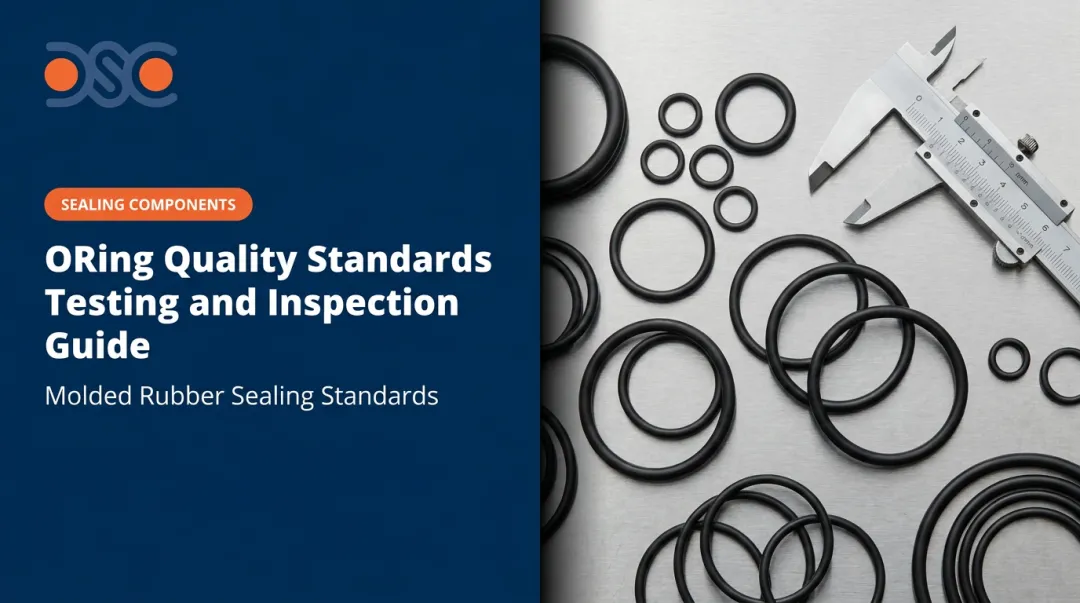
- All seals are inspected against ISO 3601-3 criteria, with optional 100% inspection and destructive testing available
- Material selection, sizing, and Shore A hardness are the three spec variables most likely to cause premature seal failure
What Makes Greene Tweed a Benchmark in O-Ring Seal Manufacturing
Greene Tweed has over 160 years of technical experience engineering specialty seals and high-performance components. Rather than competing on volume for standard industrial O-rings, they focus on applications where seal failure simply isn't an option.
The industries they serve — semiconductor, aerospace, defense, oil and gas, chemical processing — all share one characteristic: the assets these seals protect are worth far more than any individual seal component. A failed compressor seal on an offshore platform or a contaminated semiconductor process chamber creates losses no procurement savings can offset.
This strategic focus drives three downstream decisions that distinguish Greene Tweed from general-purpose seal manufacturers:
- Develops proprietary compound families — Chemraz®, Fluoraz®, Fusion®, and Xyfluor® — engineered for specific performance gaps rather than sourcing standard elastomers
- Uses specialized manufacturing methods, including proprietary processes for large-diameter O-rings that conventional presses cannot produce
- Applies rigorous quality standards under ISO 3601-3, with optional 100% inspection and destructive testing for extreme-duty applications
Understanding each of these choices explains why Greene Tweed seals command a premium — and why that premium is justified in high-stakes applications.
Greene Tweed's O-Ring Material Portfolio
Material selection is where most O-ring engineering decisions get made — and where most failures originate. Greene Tweed's compound families are tiered by performance, with each grade targeting a specific combination of chemical exposure, temperature range, and cost tolerance.
Chemraz® FFKM — Highest Performance Tier
Chemraz® is Greene Tweed's perfluoroelastomer (FFKM) line and their most specified material for extreme environments. The general Chemraz® FFKM family is rated up to 315°C / 599°F, with the Chemraz® 694 grade capable of withstanding short-term peak excursions to 316°C / 600°F during steam exposure.
Semiconductor applications where Chemraz® is specified include:
- Conductor and dielectric etch chambers
- PECVD and ALD process equipment
- Slit valves, gate valves, and pendulum valves
- Wet clean stations and chamber seals
Its broad chemical resistance makes Chemraz® the specified choice when aggressive process chemistry rules out every other elastomer. Research published in the Journal of Vacuum Science & Technology confirms that plasma environments rapidly degrade standard elastomers — which is precisely the application gap Chemraz® was developed to address.
Fluoraz® FEPM — Mid-Tier Performance
Fluoraz® sits between standard FKM and FFKM in both performance and cost. As Greene Tweed's FEPM-grade fluoroelastomer, it resists:
- Steam up to 232°C / 450°F
- Methanol, amines, ammonia, and urea
- Hydrochloric acid and other corrosive media
- Rapid gas decompression
Fluoraz® is the practical choice when FFKM's chemical resistance is required but its cost is prohibitive — common in chemical processing and industrial applications where aggressive media is present but not at semiconductor-grade purity requirements.
Fusion® FKM — Broad Industrial Coverage
When standard FKM grades run out of margin, Fusion® picks up where they leave off. Greene Tweed's premium fluorinated elastomer is rated for higher temperatures and broader chemical exposure than commercial FKM — without the cost jump to FEPM or FFKM.
Typical applications include:
- Fuel systems and volatile fluid handling
- Corrosive chemical exposure in process equipment
- Aerospace and defense components requiring elevated thermal resistance
- Semiconductor fabrication environments with moderate chemical aggression
Fusion® operating range extends beyond standard FKM, making it the practical upgrade for engineers who need more performance without committing to specialty-tier pricing.
Xyfluor® — Low-Temperature and Specialty Chemical Applications
Chemical aggression and low-temperature flexibility rarely coexist in a single elastomer — Xyfluor® is Greene Tweed's answer to that gap. Its operating range spans -60°C / -76°F to 232°C / 450°F, and it maintains performance in contact with amines, ketones, and hydrofluoric acid — media that challenge even standard FKM grades.
That -60°C floor is what sets Xyfluor® apart. Equipment in cold climates, near-cryogenic processes, or thermal cycling applications can maintain seal integrity where standard FKM would stiffen and lose conformance.
Hardness and Shore A Durometer
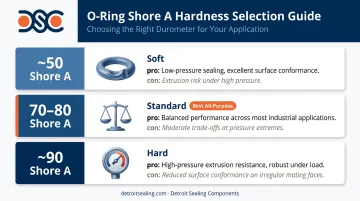
The Parker O-Ring Handbook identifies 70 to 80 Shore A as the most suitable hardness range for most industrial O-ring applications. The tradeoffs are straightforward:
- Softer compounds (~50 Shore A): Better surface conformance at low pressures, but prone to abrasion and extrusion under load
- 70–80 Shore A: Best balance of sealing force and extrusion resistance for general use
- Harder compounds (~90 Shore A): Maximum extrusion resistance under high pressure, but reduced surface conformance
Always cross-reference the compound's properties sheet against the application's chemical exposure, temperature range, and pressure before specifying a hardness grade.
How Greene Tweed Manufactures O-Ring Seals
Standard Compression Molding
The baseline process for most Greene Tweed O-rings is compression molding. Compound is placed in a mold cavity, then heat and pressure cure the material to shape. The seal is de-flashed and buffed to final dimensions.
This method is reliable, well-understood, and cost-effective for standard-size O-rings within the physical constraints of a molding press. It covers the majority of applications where large-diameter tooling is not required.
When O-ring diameter exceeds what a conventional press can accommodate, Greene Tweed's Extensis® method takes over. The process uses partially cured extrudate segments bonded together with a proprietary curing agent that is chemically similar to the base compound. The segments are then post-cured and de-flashed to final specification.
Key specifications:
- Minimum inner diameter: 42 inches
- No maximum inner diameter
- Available compounds include Fusion® 707, Chemraz® 513, and Chemraz® 517
The bonded joint is far stronger than a standard adhesive connection — it performs at or near the mechanical properties of the base compound. This makes Extensis® the practical choice for large-diameter applications where conventional molding tooling simply doesn't exist.
Large-Diameter O-Rings: Horseshoe Molding
Horseshoe molding is Greene Tweed's process for large-diameter O-rings in demanding conditions: high-pressure systems, hard vacuum environments, and dynamic sealing applications like oil and gas compressors.
Unlike Extensis®, horseshoe molding uses uncured extrudate placed in a horseshoe-shaped mold cavity and continuously vulcanized. The result is a fully homogeneous joint — not a bonded interface, but a single unified cross-section throughout the O-ring.
Selection logic between the two methods:
| Factor | Extensis® | Horseshoe Molding |
|---|---|---|
| Joint type | Bonded extrudate | Homogeneous (no joint interface) |
| Application range | Broad large-diameter needs | High-pressure, vacuum, dynamic |
| Typical use | Industrial large-diameter seals | Oil & gas compressors, critical equipment |
| Minimum ID | 42 inches | Contact Greene Tweed for specification |
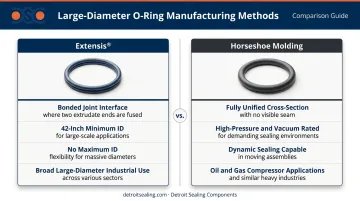
When joint homogeneity is non-negotiable — pressure-rated systems, vacuum integrity, or dynamic cycling — horseshoe molding is the right specification.
Greene Tweed O-Ring Quality Standards and Inspection
ISO 3601-3 as the Quality Framework
Greene Tweed applies ISO 3601-3:2005 as the governing standard for O-ring dimensional and visual inspection. The standard defines:
- Dimensional tolerances for inner diameter and cross-section
- Surface finish requirements and permissible imperfection limits
- Grade N (general purpose) and Grade S (special applications with tighter acceptance criteria)
ISO 3601-3 is the specific acceptance framework that determines whether a seal passes or fails inspection before it ships — not a general quality aspiration.
Inspection Methods
Dimensional and visual inspection uses a combination of standard measurement tools and optical non-contact measurement systems. The optical systems catch dimensional deviations that manual gauging can miss, including cross-section concentricity issues and subsurface surface imperfections.
For critical applications, Greene Tweed offers:
- 100% inspection — every seal is individually measured rather than lot-sampled
- ISO 10423 destructive testing with high-magnification crack verification — applicable to extreme-duty seals for oil and gas wellhead and Christmas tree equipment
These options matter when the cost of a single field failure — whether in an offshore compressor or an aerospace hydraulic system — justifies the additional inspection investment.
DSC's ISO 17025 Lab as a Complementary Resource
Engineers sourcing Greene Tweed-equivalent or custom elastomer compounds can use DSC's ISO 17025 accredited laboratory for independent material testing and compound validation. The lab supports custom material development when a suitable off-the-shelf compound doesn't exist, and runs controlled reliability testing that replicates actual service conditions.
This is useful for engineers who need to confirm compound performance before committing to a production run.
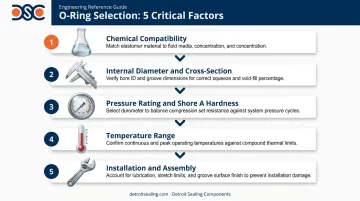
Selecting the Right Greene Tweed O-Ring: Five Factors
Getting the specification right upfront prevents the two most common failure modes: material degradation and dimensional mismatch. Each factor below narrows the field toward the correct compound and size for your application.
1. Chemical Compatibility
No single material suits all applications. Cross-reference the compound's chemical resistance chart against every fluid, gas, or solvent the O-ring will contact — not just the primary process media. Cleaning agents, lubricants, and incidental exposure matter.
2. Internal Diameter and Cross-Section
The internal diameter must match the groove geometry precisely. The cross-section thickness affects both sealing force and clearance requirements. Dimensional mismatch is actually one of the most common causes of premature O-ring failure — more frequent than material selection errors or installation technique.
3. Pressure Rating and Shore A Hardness
Per Parker's O-Ring Handbook, harder compounds provide greater extrusion resistance under high pressure. The O-ring's pressure rating must meet or exceed the application's operating pressure, and hardness should be selected to match:
- High-pressure systems → 80 Shore A or harder
- Low-pressure, static applications → softer compounds for better surface conformance
4. Temperature Range
Verify both continuous operating temperature and peak excursion temperature. Chemraz® 694, for example, handles extended steam at 260°C but can tolerate short-term peaks to 316°C. Specifying a seal based only on continuous operating temperature misses the thermal events that actually cause failure.
5. Installation and Assembly
Parker's O-Ring Handbook identifies twisting, excessive stretch, improper lubrication, and installation damage as primary contributors to early failure. Practices that prevent installation damage:
- Slide O-rings into place — don't roll them
- Use a lubricant compatible with the elastomer compound and process media
- Avoid sharp edges during installation that can nick or cut the seal profile
Industries Where Greene Tweed O-Ring Seals Are Specified
Greene Tweed's materials and manufacturing methods map directly to specific industry requirements:
| Industry | Application | Greene Tweed Solution |
|---|---|---|
| Semiconductor | Plasma etch chambers, CVD equipment | Chemraz® FFKM for fluorine/oxygen plasma resistance |
| Oil & Gas | Compressors, wellhead equipment | Horseshoe-molded large-diameter seals |
| Aerospace & Defense | Landing gear, hydraulics, fuel systems | Fusion® FKM and Chemraz® for wide temperature ranges |
| Chemical Processing | Aggressive media streams | Fluoraz® FEPM and Xyfluor® for amine/ketone/HF resistance |
Greene Tweed specifications extend beyond these four verticals. Food and beverage, life sciences, and renewable energy applications also call for these materials — anywhere chemical exposure, temperature extremes, or pressure cycles rule out standard elastomers.
DSC stocks and distributes sealing components across all of these verticals nationwide. Their technical team can help engineers select the right grade for a given application, with compound testing and validation support through their ISO 17025 accredited lab.
Frequently Asked Questions
What does Greene Tweed make?
Greene Tweed manufactures high-performance specialty seals and engineered components — including O-rings, T-seals, rotary seals, and electrical connectors — for demanding industries such as aerospace, semiconductor, oil and gas, chemical processing, and defense. Their focus is on applications where standard elastomers cannot maintain performance.
Which material is best for an O-ring?
The best material depends on chemical exposure, temperature range, and pressure requirements. Chemraz® FFKM suits the most aggressive environments, Fusion® FKM covers a broad range of industrial uses, and Fluoraz® FEPM bridges the gap for steam and amine resistance — while NBR or EPDM may suffice for less demanding applications.
What is Chemraz® and when should it be used?
Chemraz® is Greene Tweed's proprietary FFKM perfluoroelastomer, rated up to 315°C / 599°F with near-universal chemical resistance. It's the correct choice for semiconductor plasma processes, harsh chemical environments, and high-temperature applications where standard fluoroelastomers would degrade.
How does Greene Tweed manufacture large-diameter O-rings?
Greene Tweed uses two methods: the Extensis® bonded extrudate process for inner diameters starting at 42 inches with no upper limit, and horseshoe molding for high-pressure or dynamic applications requiring a fully homogeneous (non-bonded) joint cross-section.
What quality standards govern Greene Tweed O-ring seals?
Greene Tweed applies ISO 3601-3 criteria for dimensional and visual inspection, covering tolerances, surface finish, and permissible imperfections. Optional 100% inspection and ISO 10423 destructive testing are available for critical applications in oil and gas and other extreme-duty sectors.
Can Greene Tweed O-ring seals be sourced through distributors?
Yes. Distributors like DSC offer more than availability — including compound selection guidance, custom material development, and independent testing through their ISO 17025 accredited lab to validate performance before committing to production.