The stakes are real: lubricant-elastomer compatibility directly controls seal longevity, friction behavior, and system reliability. Yet lubricant selection is often treated as an afterthought — grabbed off the shelf at installation rather than specified during design.
This guide covers the main lubricant categories, what makes each suitable or unsuitable for specific applications, and the selection criteria that should drive every lubrication decision — from O-ring material type to regulatory compliance.
Key Takeaways
- Silicone-based lubricants are the safest, broadest-compatibility choice for most elastomeric O-rings
- Petroleum-based products (Vaseline, WD-40, mineral oil) degrade most rubber compounds — never use them on rubber O-rings
- Match lubricant to elastomer type, operating temperature, chemical exposure, and regulatory requirements
- At installation, apply a thin, uniform film; reapply at scheduled maintenance intervals
- For regulated or demanding applications, verify lubricant compatibility with a sealing specialist before assembly
What Is O-Ring Lubrication and Why Does It Matter?
O-ring lubrication is the application of a chemically compatible lubricant to the seal surface before or during installation. The goal is to reduce friction, prevent assembly damage, and protect the elastomer throughout its service life — not just at the moment of installation.
According to the Parker O-Ring Handbook, lubrication provides its greatest benefit during initial installation, protecting O-rings from abrasion, pinching, cutting, twisting, and seating errors. In pneumatic applications, the same source warns that skipping lubrication leads to high friction, excessive abrasion, and heat buildup — all of which shorten seal life.
Benefits of Proper O-Ring Lubrication
Done correctly, lubrication delivers measurable operational value:
- Prevents tearing, twisting, and improper seating during assembly
- Reduces wear over time, especially in dynamic (reciprocating or rotary) applications
- Helps O-rings seat uniformly in the gland, lowering the risk of vacuum or pressure leakage
- Limits dry-run degradation in pneumatic systems where friction accelerates elastomer wear
- Creates a barrier against ozone, moisture, and atmospheric attack in exposed environments
For dynamic seals, the lubricant film needs to be stable enough to stay in place under continuous O-ring motion — not just coat the surface at assembly.
Types of O-Ring Lubricants: Pros, Cons, and Best Uses
The right lubricant depends on four variables: elastomer compound, sealed fluid or gas, operating temperature, and regulatory requirements. Getting this wrong can cause seal swelling, degraded performance, or premature failure. Here is how the main categories stack up.
Silicone-Based Lubricants
Silicone lubricants — oils and greases — are the most broadly recommended option across O-ring applications. Two products dominate most specification sheets:
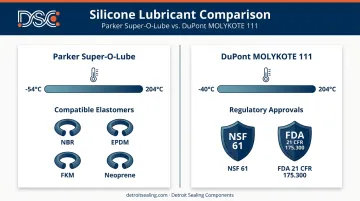
- Parker Super-O-Lube: Operates -54°C to 204°C; compatible with NBR, EPDM, FKM, and neoprene
- DuPont MOLYKOTE 111: Silicone oil compound with inorganic thickener; covers -40°C to 204°C; meets NSF 61 and FDA 21 CFR 175.300 for potable water and food-contact use
One important exception: silicone lubricants used on silicone (VMQ) O-rings require caution. Marco Rubber notes that only a thin film of Super-O-Lube should be applied to silicone rubber when temperatures exceed 300°F. Confirm compatibility with the specific compound before use.
PTFE-Based Lubricants
When silicone isn't viable for aggressive media, PTFE-based lubricants are the next step up. Krytox — one of the leading PTFE/PFPE-based product lines — delivers performance silicone cannot:
- Chemically and biologically inert
- Silicone-free, VOC-free, and nonflammable
- Resistant to steam, acidic cleaners, and caustic cleaners
These properties make Krytox a go-to for semiconductor manufacturing, pharmaceutical production, and oil & gas applications.
These lubricants typically carry a higher unit cost and may require more frequent reapplication, but in critical systems handling aggressive media, the performance justifies both.
Ester-Based Lubricants
Ester-based (synthetic ester) lubricants offer a strong middle ground — waterproof, low-volatility, compatible with most synthetic elastomers, biodegradable, and low in toxicity. P-80 Emulsion IFC and P-80 THIX IFC, for example, are NSF H1 listed and meet FDA 21 CFR 178.3570, making them appropriate for food-contact and sanitary applications.
P-80 also notes its emulsion products reduce friction by approximately 70% during assembly — meaningful in tight-tolerance applications where installation force can cause seal damage.
Fluorocarbon Gel Lubricants
Fluorocarbon/PFPE greases handle operating conditions that other lubricants simply cannot. MIL-PRF-27617G defines aerospace-grade fluorinated greases covering -73°C to 232°C depending on type — a range well beyond silicone's limits.
Cost and lead time are real trade-offs. For aerospace, high-performance automotive, and harsh chemical exposure scenarios, however, they are often the only technically sound choice for safety-critical sealing systems.
Lubricants to Avoid and Why
Several common products should never be used on rubber O-rings:
- Vaseline (petroleum jelly) — petroleum-based; causes swelling and elastomer breakdown in most rubber compounds
- WD-40 and general-purpose spray lubricants — hydrocarbon-based; incompatible with most elastomers
- Mineral oil — degrades NBR and most general-purpose rubber; use only where elastomer compatibility has been formally verified
- Soap-and-water solutions — inconsistent film, can reactivate in wet environments post-assembly, not a reliable lubricant
- Solvent-based products — chemical attack risk on elastomers; high VOC content creates additional safety concerns
Parker O-Lube is a mineral oil-based grease rated for hydrocarbon and pneumatic service, but only where elastomer compatibility is explicitly confirmed — it is not a general-purpose substitute for silicone-based products.
Quick-Reference Comparison
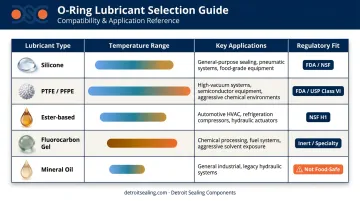
| Lubricant Type | Temp Range | Key Applications | Regulatory Fit |
|---|---|---|---|
| Silicone (e.g., Super-O-Lube) | -54°C to 204°C | General industrial, pneumatic, water | NSF 61, FDA 21 CFR 175.300 |
| PTFE/PFPE (e.g., Krytox) | Varies by grade | Semiconductor, pharma, oil & gas | Inert; grade-dependent |
| Ester-based (e.g., P-80) | Wide range | Food & beverage, sanitary assembly | NSF H1, FDA 21 CFR 178.3570 |
| Fluorocarbon gel (MIL-spec) | -73°C to 232°C | Aerospace, extreme chemical exposure | MIL-PRF-27617G |
| Mineral oil (e.g., Parker O-Lube) | Limited | Hydrocarbon/pneumatic (verified only) | Not general-purpose |
Key Factors for Selecting the Best O-Ring Lubricant
Lubricant selection is an engineering decision, and the right choice depends on five variables: elastomer chemistry, operating temperature, fluid exposure, seal motion type, and regulatory requirements.
O-Ring Material Compatibility
Material compatibility is the first and non-negotiable filter. Each elastomer reacts differently to lubricant chemistries — incompatible pairings cause swelling, hardening, or loss of elastic recovery.
| Elastomer | Compatible Lubricants | Avoid |
|---|---|---|
| NBR (Nitrile) | Silicone-based, PTFE-based | Petroleum-based products |
| EPDM | Silicone-based | Petroleum-based products |
| FKM (Viton) | Silicone-based, PTFE/PFPE-based | Verify before using mineral oils |
| Silicone (VMQ) | Thin silicone film (verify formulation) | Excess silicone; some formulations may swell |
| Neoprene (CR) | Silicone-based | Petroleum-based products |
| PTFE | Verify product-specifically | No universal compatibility assumption |
Operating Temperature Range
Temperature directly affects lubricant viscosity and stability. A lubricant that performs at room temperature may thin excessively at high heat or become too viscous to function in cold environments — both conditions lead to inadequate film protection and seal failure.
Practical reference ranges:
- Silicone (Super-O-Lube): -54°C to 204°C
- Silicone compound (MOLYKOTE 111): -40°C to 204°C
- Mineral oil grease (Parker O-Lube): -29°C to 82°C
- Aerospace fluorinated grease (MIL-PRF-27617G): -73°C to 232°C (type-dependent)
Chemical and Fluid Exposure
The lubricant must remain inert relative to the process fluid, gas, or surrounding media. When a lubricant reacts with system fluids, it degrades both the seal and the lubricant film simultaneously, accelerating failure through two mechanisms at once.
Industry-specific considerations:
- Potable water systems: Lubricant must comply with NSF/ANSI 61, which covers sealing and joining materials that contact drinking water
- Food & beverage: FDA 21 CFR 178.3570 governs lubricants with incidental food contact — compliance is product-specific, not category-wide
- Hydraulic systems: Verify lubricant stability against the specific hydraulic fluid in use
Application Type: Static vs. Dynamic
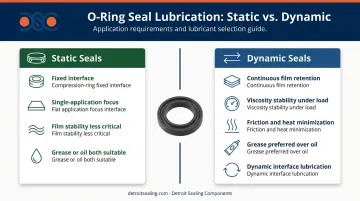
Static seals (face seals, fixed interfaces) and dynamic seals (reciprocating pistons, rotating shafts) have different lubrication demands.
For dynamic applications, the critical factors shift:
- Must retain a protective film under shear without being wiped away by O-ring motion
- Must maintain viscosity over time — thin oils lose protection faster under load
- Must minimize friction to reduce heat buildup and wear across continuous cycles
Grease formulations generally outperform oils in dynamic applications because they maintain a thicker film under mechanical stress.
Regulatory and Environmental Requirements
Performance criteria alone don't determine the right lubricant — regulated industries add a compliance layer that narrows the field further:
- NSF 61 — required for potable water contact; covers lubricants, gaskets, and sealing materials
- FDA 21 CFR 178.3570 — governs incidental food-contact lubricants in food processing environments
- MIL-PRF-27617G — defines aircraft and instrument greases for aerospace applications
- NSF H1 — food-grade designation for lubricants used in food and beverage processing equipment
Using a non-compliant lubricant in a regulated application risks failed inspections, contamination liability, and warranty voidance. Compliance must be confirmed at the product formulation level, not inferred from the lubricant category.
How Detroit Sealing Components (DSC) Can Help
Lubricant selection gets complicated fast when elastomer compounds, operating conditions, and regulatory requirements all overlap. Detroit Sealing Components (DSC) helps customers work through that complexity before it creates a field problem.
DSC is more than an O-ring distributor. With decades of experience in the precision molded rubber industry and an ISO 17025 accredited laboratory, DSC helps customers confirm material-lubricant compatibility before a seal failure forces the question.
Their technical staff supports application-specific sealing decisions across a wide range of industries:
- Automotive and aerospace
- Oil & gas and hydraulic/pneumatic systems
- Food & beverage and drinking water
- Healthcare and semiconductor manufacturing
- Renewable energy and general industrial
Relevant capabilities include:
- Access to hundreds of elastomer compounds across all rubber types — NBR, EPDM, FKM, VMQ, HNBR, FFKM, and more
- ISO 17025 accredited lab for material testing, compound development, and reliability design verification
- Custom-molded O-rings and complex sealing profiles (X-rings, diaphragms, hydraulic seals, gaskets, infinite-size O-rings)
- Computer-aided design and finite element analysis (FEA) for predicting seal behavior under real operating conditions
- Optional surface treatments including coatings and lubricants for ease of assembly and optimal performance
- Nationwide distribution from Plymouth, MI, with stocking inventory for standard and specialized applications

If your application involves a regulated environment or an unusual elastomer compound, DSC's technical staff can identify the right material-lubricant pairing before your application goes to production. Reach out directly when standard guidance leaves gaps.
Conclusion
The best O-ring lubricant is not the most convenient one within reach. The right choice depends on three factors:
- Chemical compatibility with the elastomer
- Suitability for the operating temperature and fluid environment
- Compliance with applicable regulatory standards
Silicone-based lubricants cover most scenarios well. PTFE and fluorocarbon products handle the extremes. Petroleum-based products should be avoided on rubber O-rings entirely.
Lubricant selection is not a one-time decision. When materials change, operating conditions shift, or seals come back out for service, re-evaluate the lubrication strategy alongside the seal itself. The right lubricant at every service interval is what keeps sealing systems performing — not just initially, but over the full service life of the assembly.
Frequently Asked Questions
What is the best lubricant for O-rings?
Silicone-based lubricants are the most broadly recommended option for most elastomers — chemically inert, waterproof, and stable across a wide temperature range. That said, application-specific factors like elastomer type, chemical exposure, and regulatory requirements should always guide the final selection rather than defaulting to a single product.
Are Vaseline, lithium grease, or WD-40 safe to use on O-rings?
Vaseline and WD-40 are petroleum-based and should never be used on rubber O-rings: both cause elastomer swelling and accelerated degradation. Lithium grease compatibility varies by base oil chemistry and elastomer type and must be verified against the specific compound before use.
Can I use the same lubricant on all O-ring materials?
No. Lubricants are not universally compatible across elastomers. Silicone lubricants require caution with silicone (VMQ) O-rings, and petroleum-based products damage most rubber compounds. Always verify compatibility against the specific material before applying any lubricant.
When should lubricant be applied to O-rings?
At installation — always. Lubrication at assembly prevents installation damage like tearing, twisting, and improper seating. It should also be reapplied during routine maintenance or whenever seals are inspected or replaced to maintain optimal performance.
How much lubricant should I apply to an O-ring?
A thin, uniform film is all that is needed. Parker specifies that assembly lubricants should be used sparingly — a light film is sufficient. Excess lubricant does not improve performance and can attract contaminants or complicate assembly.
What happens if you don't lubricate an O-ring?
Unlubricated O-rings are significantly more prone to installation damage (tearing, twisting, improper seating) and accelerated wear in dynamic applications. Parker notes that in pneumatic systems, omitting lubrication results in high friction, excessive abrasion, and heat buildup that shorten seal service life.