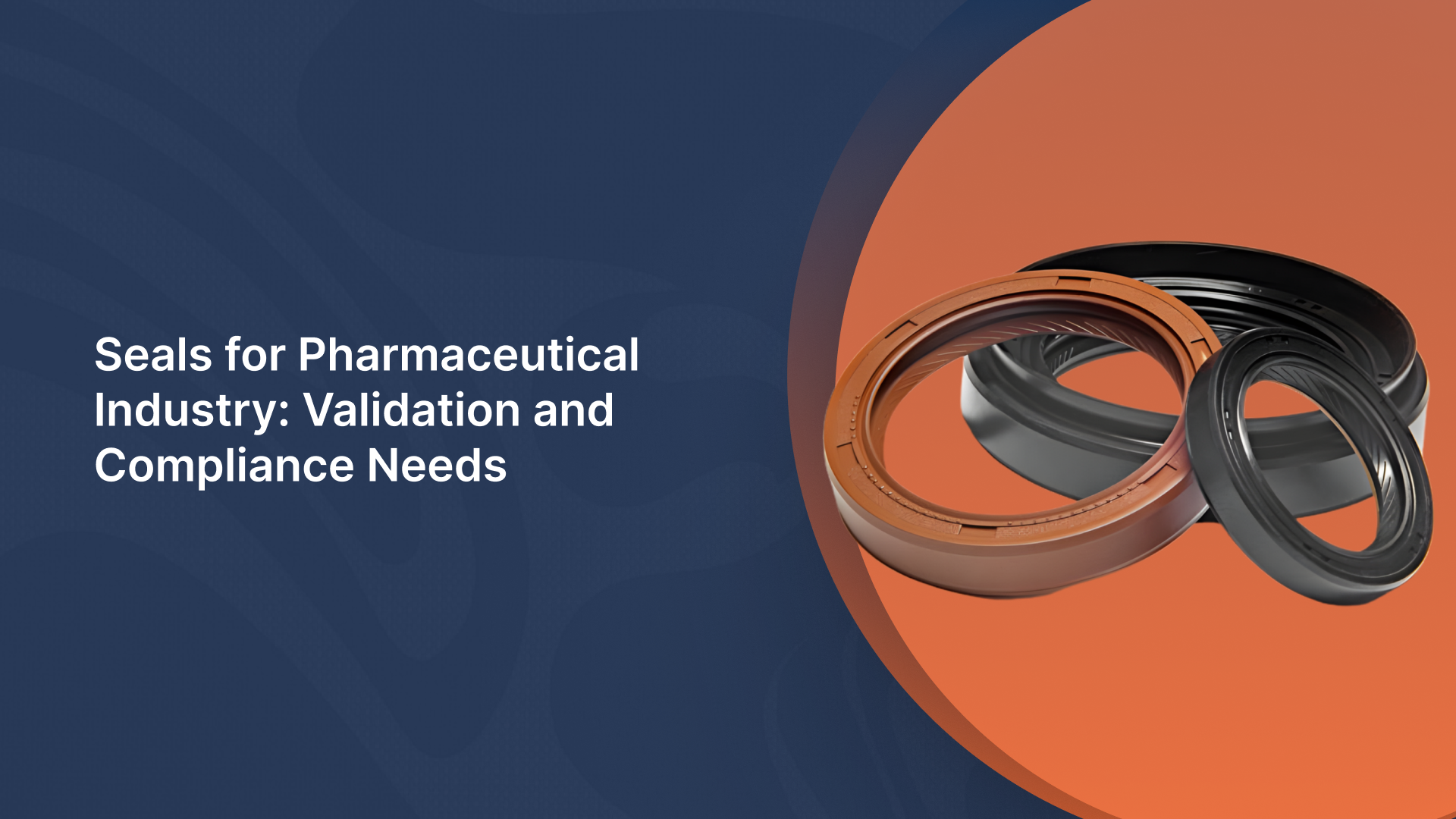
A seal failure in a regulated environment is rarely just a minor component issue; it often escalates into validation delays, compliance observations, or unplanned downtime that affects the entire operation. For teams responsible for quality, engineering, or procurement, seals for pharmaceutical industry applications sit at the intersection of product integrity, regulatory scrutiny, and operational continuity.
This risk is becoming more visible as regulatory oversight intensifies and tolerance for preventable failures continues to narrow. The FDA’s Report on the State of Pharmaceutical Quality, updated as of December 2025, reflects ongoing trends in quality surveillance that increasingly focus on system-level controls rather than isolated components.
In this context, seals for the pharmaceutical industry use play a direct role in contamination control, material compatibility, and validation outcomes across packaging, storage, and fluid-handling systems. This article explains how sealing decisions influence compliance, audit readiness, and long-term reliability, so you can reduce risk, save time, and avoid costly corrective actions.
Key Takeaways
Seals directly affect contamination control, validation status, and system reliability across pharmaceutical manufacturing and packaging operations.
Regulatory reviews assess seals through system performance, documentation, change control, and long-term behavior, not material approval alone.
Seal performance influences IQ, OQ, and PQ outcomes, with failures often leading to revalidation, audit findings, or production delays.
Clean manufacturing, traceability, and qualified suppliers determine whether sealing systems remain compliant throughout their service life.
Why Seals Are Validation-Critical in Pharma Operations?
Seals are validation-critical because they directly influence contamination control, process integrity, and the repeatability of regulated pharmaceutical operations.
In practical terms, here’s why sealing decisions are treated as part of the validation boundary, not a peripheral hardware choice:
They form part of the product-contact and product-adjacent system: Even when seals do not directly contact the drug, they can affect sterile barriers, fluid pathways, and enclosed environments that regulators view as integral to product safety.
They impact contamination control at multiple points: Degraded, incompatible, or poorly fitted seals can introduce particles, leachables, or microbial risk—triggering deviations during routine monitoring or audits.
They influence system repeatability and process consistency: Validation assumes consistent performance over time. Seal wear, compression set, swelling, or extrusion can alter system behavior and invalidate previously qualified conditions.
They are evaluated indirectly during inspections: Inspectors may not ask about seals explicitly, but failures often surface through leaks, pressure loss, cleaning inefficiencies, or unexplained process variability.
They can trigger revalidation when changed: A material change, geometry substitution, or supplier switch may require impact assessment, documentation updates, and partial or full requalification.
They affect downtime and corrective action costs: Seal-related issues frequently lead to line stoppages, investigations, corrective actions, and delayed releases, costs that compound quickly in regulated environments.
Once seals are recognized as part of the validation boundary, the next question becomes how regulators actually assess them during inspections.
How Regulatory Bodies Evaluate Seals in Pharma Systems?
Regulatory bodies assess seals for pharmaceutical industry applications as part of the validated system, focusing on whether sealing performance consistently supports product quality, patient safety, and regulatory compliance over time.
In practice, this evaluation typically happens through the following lenses:
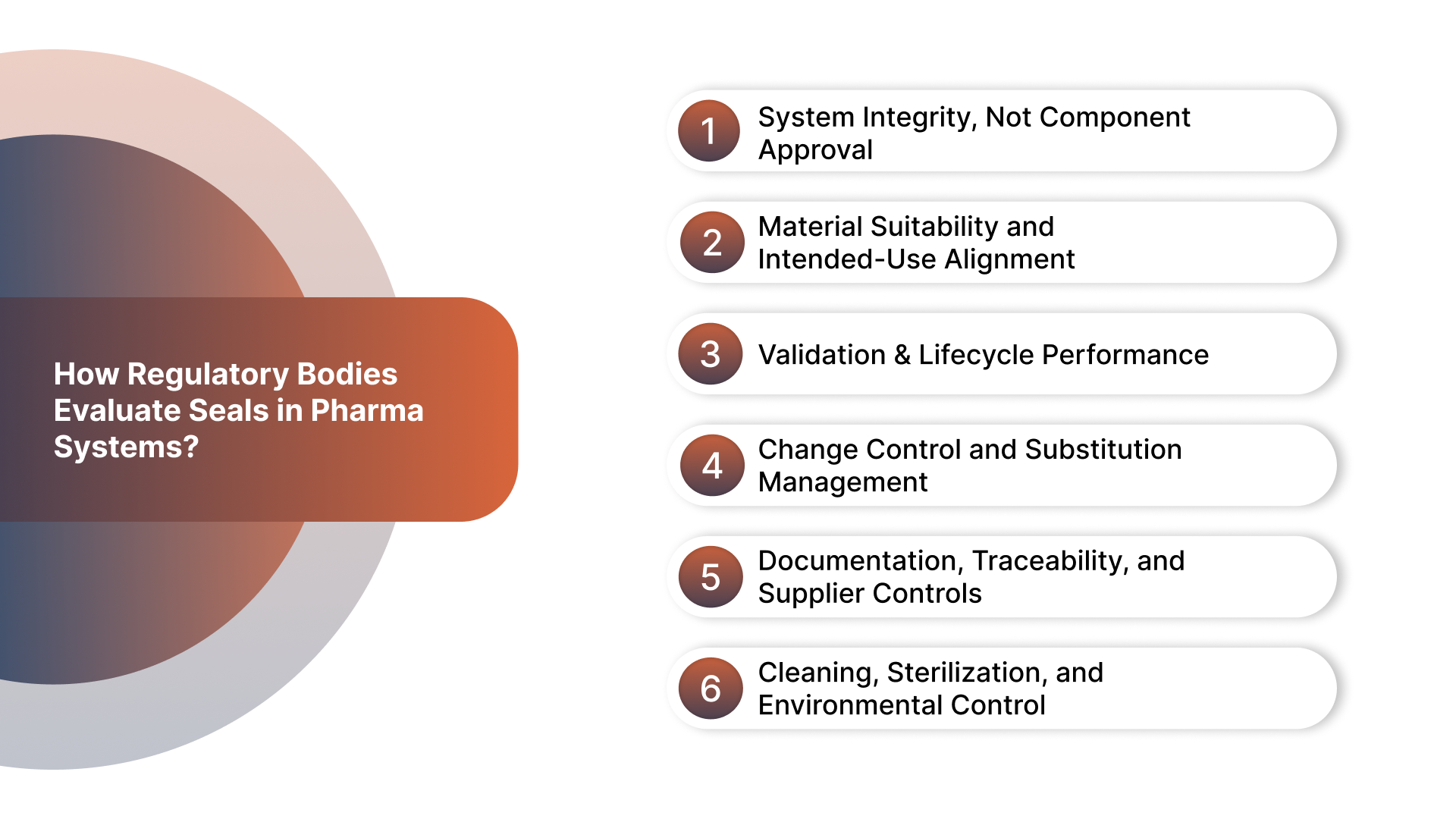
System integrity, not component approval
The U.S. Food and Drug Administration does not “approve” seals as standalone items.
Instead, they evaluate whether seals help maintain closed systems, sterile boundaries, and controlled process conditions under validated use.
Material suitability and intended-use alignment
Inspectors look for evidence that seal materials are appropriate for contact media, operating temperatures, pressures, and cleaning chemicals.
Alignment with United States Pharmacopeia requirements (such as USP <87>, <88>, and Class VI) is reviewed as part of overall risk control, not as a guarantee of compliance.
Validation and lifecycle performance
Seals are expected to perform consistently throughout their service life, not just at installation.
Regulators assess whether sealing performance has been considered during qualification and remains stable during routine operation.
Change control and substitution management
Any seal change, material, geometry, supplier, or formulation can trigger scrutiny.
Inspectors expect documented impact assessments showing whether revalidation or additional testing was required.
Documentation, traceability, and supplier controls
Audits often include a review of certificates of compliance, material traceability, and supplier qualification records.
Lack of clear documentation is frequently treated as a system weakness, even when no failure has yet occurred.
Cleaning, sterilization, and environmental control
Seal performance under repeated CIP/SIP cycles or sterilization processes is closely examined.
Expectations often align with clean manufacturing and environmental control principles defined in standards such as the International Organization for Standardization ISO 14644.
These regulatory expectations take shape during qualification, where sealing performance is examined across installation, operation, and long-term use.
Role of Seals Across IQ, OQ, and PQ Validation
In pharmaceutical operations, seals for pharmaceutical industry applications play a measurable role across every validation phase, influencing whether equipment, processes, and systems can be qualified, maintained, and defended during audits.
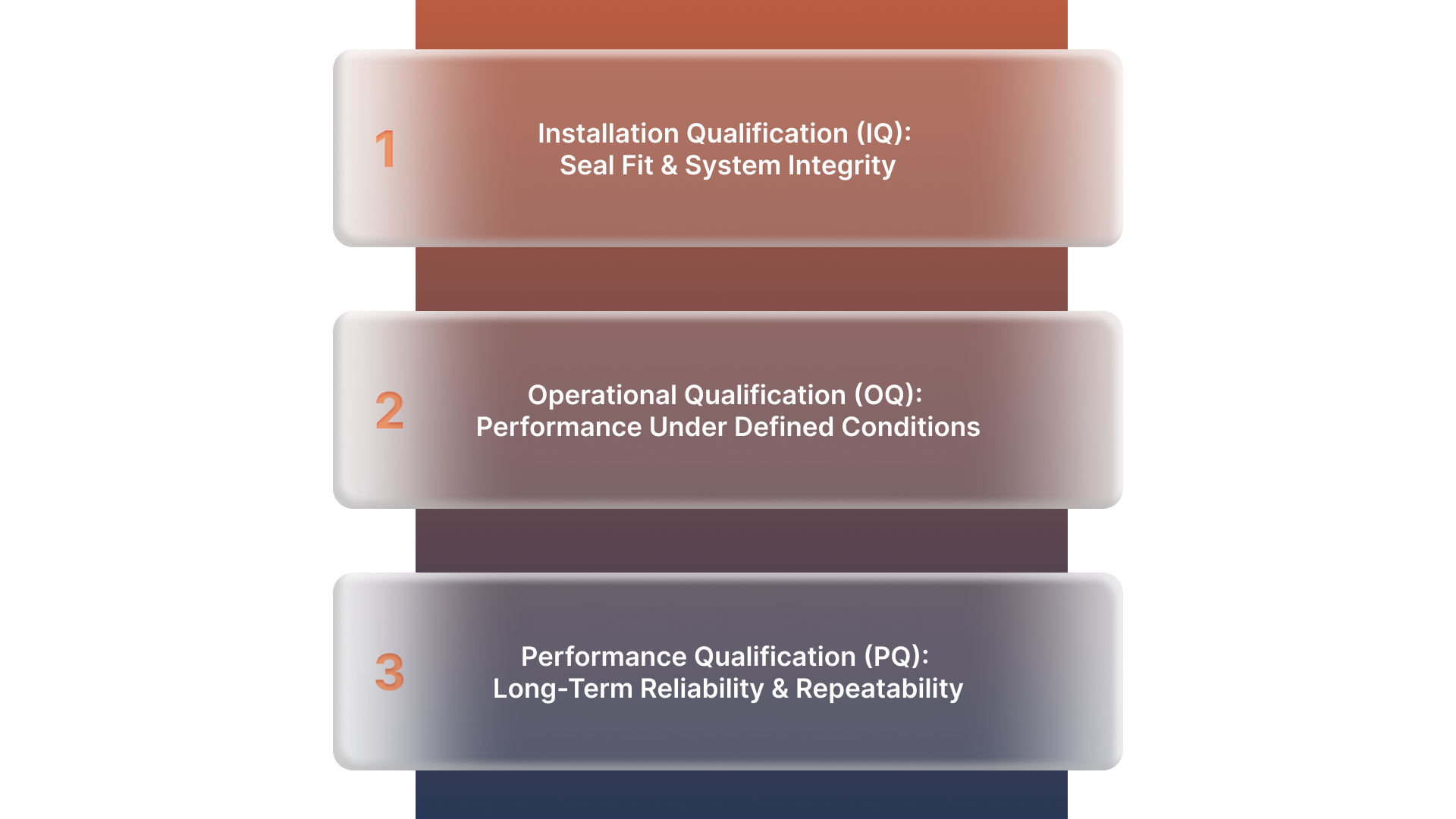
Below is how seals factor into each validation stage, and why overlooking them creates avoidable risk.
Installation Qualification (IQ): Seal Fit and System Integrity
During IQ, seals establish whether the equipment is built and assembled exactly as intended under validated conditions.
At this stage, the focus is on confirming that the sealing system matches approved specifications and installation requirements.
This typically includes:
Verifying seal geometry, dimensions, and gland fit against approved drawings
Confirming material grades align with validation and compliance documentation
Ensuring seals are installed correctly without damage, distortion, or stress
Recording seal specifications as part of the equipment baseline
Linking seals to approved suppliers and traceable documentation
If a seal does not match the validated configuration at IQ, downstream qualification efforts may be invalid before operations even begin.
Operational Qualification (OQ): Performance Under Defined Conditions
OQ evaluates whether seals perform reliably when the system operates within defined process limits.
Here, seals are tested indirectly through their ability to maintain pressure, containment, and integrity under real operating conditions.
Key considerations include:
Performance under operating temperatures, pressures, and flow rates
Resistance to process media, solvents, and cleaning agents
Ability to maintain sealing force during repeated operational cycles
Absence of leakage, extrusion, or abnormal wear during stress testing
Stability during simulated cleaning or sterilization conditions
Seal issues uncovered during OQ often reveal material incompatibility or design limitations that were not obvious during installation.
Performance Qualification (PQ): Long-Term Reliability and Repeatability
PQ confirms that seals continue to perform consistently during routine production over time.
This phase matters most for ongoing compliance, because it reflects real-world use rather than controlled testing.
Typical PQ-related seal expectations include:
Consistent sealing performance across extended production runs
Resistance to compression set, swelling, cracking, or degradation
No increase in contamination risk over time
Predictable replacement intervals aligned with maintenance plans
Stable performance through repeated CIP/SIP or sanitation cycles
Seal-related failures during PQ frequently lead to investigations, corrective actions, and questions about the original validation assumptions.
Even when qualification is addressed, many teams assume material approvals alone are enough to stay compliant.
Why Material Compliance Alone Fails in Pharma Sealing?
Material compliance alone is insufficient because seals for pharmaceutical industry applications are validated based on system performance, not material certifications.
In regulated pharmaceutical environments, this limitation becomes clear in several operational and compliance scenarios:
Compliant materials can still fail under real process conditions: A pharmacopeial-compliant material may degrade when exposed to actual pressures, temperatures, and aggressive cleaning chemicals.
Manufacturing and formulation differences affect seal behavior: Changes in compounding, curing, or molding processes can impact compression set, wear resistance, and long-term sealing reliability.
Seal geometry and gland design directly influence performance: Incorrect tolerances or groove design can cause leakage or premature failure, even when compliant materials are used.
Regulators expect performance throughout the seal lifecycle: Seals must maintain integrity across repeated CIP, SIP, and sterilization cycles during routine production.
Audit readiness depends on documentation, not material labels: Material certificates alone do not demonstrate control without traceability, validation linkage, and change management records.
Supplier qualification underpins defensible material compliance: Without documented supplier controls, material compliance becomes difficult to justify during regulatory inspections.
Many of these audit findings trace back not to the seal itself, but to how suppliers are selected and managed.
Seal Failure Risks During Audits and Inspections
Seal failures create heightened audit and inspection risk because seals for pharmaceutical industry applications directly affect validated system integrity.
During regulatory inspections, seal-related issues commonly surface through the following risk areas:
Unexpected leakage triggers compliance investigations: Visible leaks often prompt inspectors to question equipment qualification, maintenance controls, and process stability.
Material degradation raises contamination concerns: Cracking, swelling, or particle shedding can indicate incompatibility with process media or cleaning agents.
Uncontrolled seal changes signal weak change management: Substitutions without documented impact assessments frequently lead to observations or corrective action requests.
Missing documentation undermines validation confidence: Lack of traceability or certification records weakens the ability to defend seal selection during audits.
Repeated seal replacements indicate systemic reliability issues: Frequent failures suggest improper material selection or inadequate lifecycle evaluation.
Cleaning and sterilization damage exposes process gaps: Seal degradation after CIP or SIP cycles may reveal unvalidated operating conditions.
Supplier controls extend beyond paperwork, especially when seals are produced or handled in contamination-sensitive environments.
Supplier Qualification Requirements for Pharma Seals
Supplier qualification is mandatory because seals for pharmaceutical industry applications fall under regulated quality systems, not discretionary purchasing decisions.
From a regulatory and audit perspective, pharma organizations are expected to qualify seal suppliers against defined legal, quality, and validation requirements, including the following:
Requirement Area | Regulatory / Compliance Basis | What Is Expected in Practice |
|---|---|---|
Supplier qualification | FDA 21 CFR Part 211.84, 211.110 | Formal supplier approval and periodic requalification |
Material control | FDA 21 CFR Part 211.65 | Verified material suitability for intended use |
Change management | FDA 21 CFR Part 211.100, 211.160 | Advance notice and documented change impact assessments |
Documentation traceability | FDA 21 CFR Part 211.180 | Batch traceability, certificates, and record retention |
Quality management system | FDA cGMP expectations | Controlled processes and corrective action procedures |
Validation support | FDA process validation guidance | Data supporting consistent seal performance |
Clean manufacturing (where applicable) | ISO 14644 principles | Environmental controls for contamination-sensitive seals |
Supplier audits | FDA inspection readiness | Audit access or documented supplier assessments |
Complaint handling | FDA 21 CFR Part 211.198 | Defined processes for failure investigation and response |
Lifecycle consistency | FDA quality systems approach | Stable formulations and controlled production methods |
When clean production, documentation, and validation expectations intersect, supplier capability makes a measurable difference.
Cleanroom Manufacturing and Traceability for Pharma Seals
Cleanroom manufacturing and traceability are essential because seals for pharmaceutical industry applications must meet strict contamination control and audit expectations.
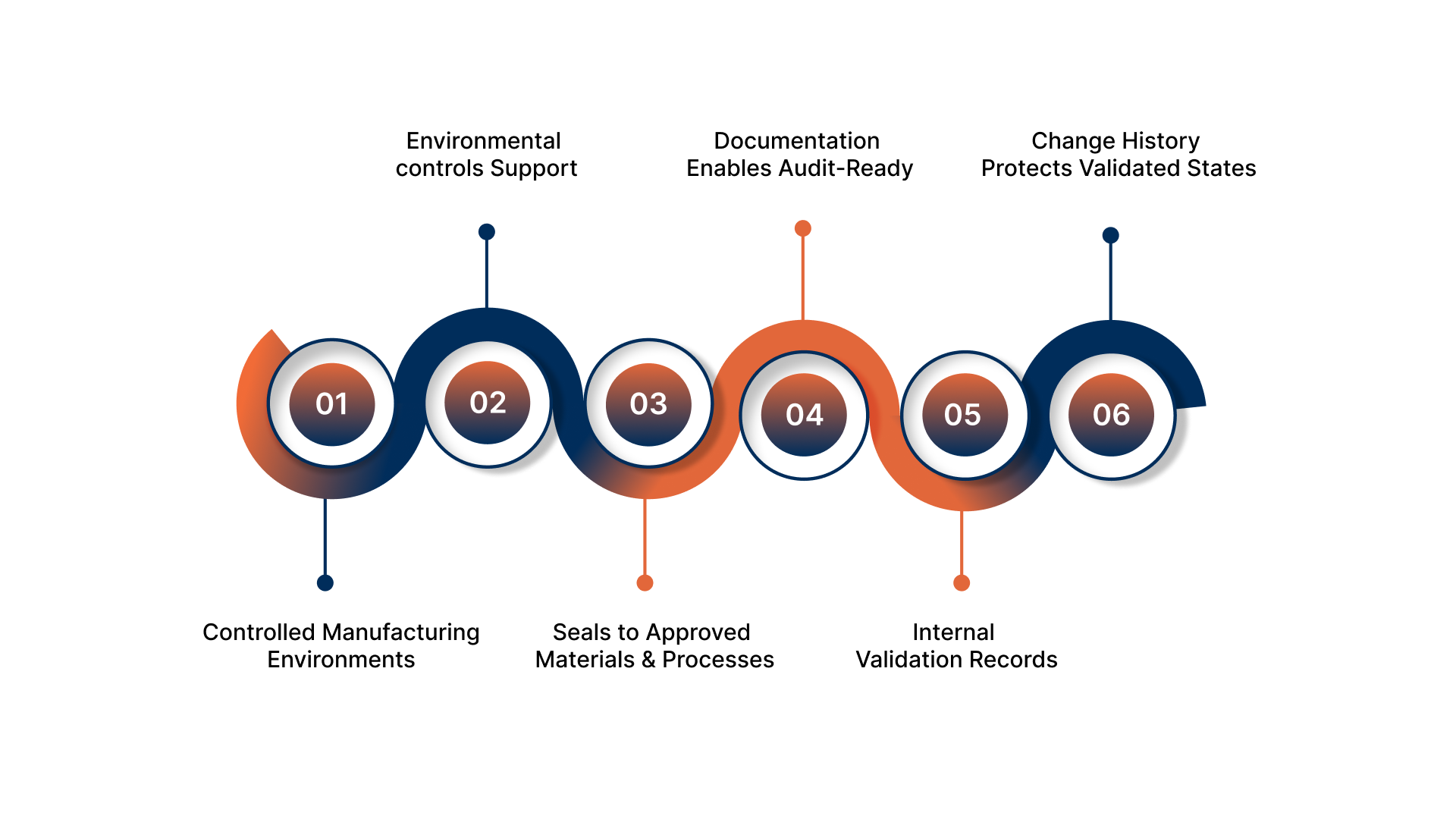
In regulated pharmaceutical environments, these requirements work together in the following ways:
Controlled manufacturing environments reduce contamination risk: Cleanroom production limits particulate, microbial, and cross-material contamination during molding and handling.
Environmental controls support validated system integrity: Cleanliness classification and handling protocols protect seals used in sterile and high-purity processes.
Traceability links seals to approved materials and processes: Batch-level records connect each seal to validated compounds, suppliers, and manufacturing conditions.
Documentation enables audit-ready compliance: Auditors expect traceable records supporting material origin, production controls, and usage history.
Certificates must align with internal validation records: Certificates of compliance support, but do not replace, qualification and validation documentation.
Change history protects validated states: Documented formulation or process changes help prevent unplanned revalidation and compliance gaps.
All of these considerations point to one conclusion: sealing decisions deserve the same discipline applied to other validated system elements.
How Detroit Sealing Components Supports Pharma Sealing Compliance?
Detroit Sealing Components supports pharmaceutical operations by supplying validated sealing solutions backed by engineering rigor, documentation control, and clean manufacturing practices.
In regulated pharma environments, this support translates into the following application-driven capabilities:
O-Rings and X-Rings for validated static and dynamic sealing: Broad standard sizing and engineered material options support repeatable performance across fluid handling and packaging systems.
Medical Seals and LSR Products for high-purity applications: Cleanroom-manufactured components using USP Class VI materials support contamination control and regulatory expectations.
Diaphragms for pumps, valves, and regulated flow control: Homogeneous and fabric-reinforced diaphragms maintain integrity under cyclic pressure and cleaning conditions.
Gaskets, Packings, and Washers for controlled static sealing: Molded solutions provide reliable sealing for housings, enclosures, and interfaces requiring validated compression performance.
TPE and TPU Seals for wear-sensitive and dynamic systems: Thermoplastic elastomers offer consistent friction control and durability where repeated motion affects system stability.
Metal-Bonded Rubber Seals for mechanically demanding interfaces: Engineered bonding supports dimensional stability and long-term reliability in mixed material assemblies.
Engineering support for material and geometry selection: Application-focused guidance helps align seal performance with process conditions and validation requirements.
Documentation and traceability aligned with audit readiness: Batch traceability and material records support supplier qualification and regulatory inspections.
For teams responsible for validated pharmaceutical systems, Detroit Sealing provides sealing solutions designed to reduce revalidation risk, improve reliability, and withstand regulatory scrutiny.
Wrapping Up
Pharmaceutical sealing decisions directly affect validation outcomes, audit readiness, and long-term operational reliability across regulated manufacturing environments. Treating seals as engineered, documented system components reduces compliance risk, prevents revalidation cycles, and protects production continuity. Detroit Sealing Components supports pharmaceutical teams with validation-ready seals, engineering guidance, clean manufacturing, and audit-defensible documentation.
Contact Detroit Sealing to evaluate your pharmaceutical sealing requirements and build a compliance-ready strategy that withstands inspections.
FAQs
What types of seals are used in the pharmaceutical industry?
Pharmaceutical systems commonly use O-rings, gaskets, diaphragms, and sanitary seals designed for contamination control and validated performance. Seal selection depends on application type, cleaning methods, pressure, temperature, and regulatory requirements.
Why are seals critical for GMP compliance in pharma manufacturing?
Seals help maintain closed systems, prevent contamination, and ensure process repeatability required under GMP regulations. Seal failures can directly lead to deviations, audit observations, or revalidation requirements.
What materials are considered compliant for pharmaceutical seals?
Common compliant materials include EPDM, silicone, FKM, PTFE-based compounds, and USP Class VI elastomers. However, material compliance alone is insufficient without validation, traceability, and lifecycle performance data.
Do seals require validation in pharmaceutical processes?
Yes, seals are indirectly validated as part of equipment and process qualification under IQ, OQ, and PQ. Changes in seal material, geometry, or supplier may trigger impact assessments or revalidation.
How do regulators inspect seals during pharmaceutical audits?
Regulators evaluate seals through system performance, documentation, change control, and contamination risk indicators. Leaks, material degradation, or missing traceability often raise inspection concerns even if seals are not directly questioned.