Introduction: When Aerospace Seals Can't Wait
Picture this: an MRO team pulls an O-ring during a routine inspection and finds it's failed. The aircraft is grounded. The replacement seal is certified, documented, and traceable — but it's sitting in a supplier's production queue three weeks out.
Every hour that aircraft stays on the ground carries real financial weight. According to IAG Cargo, a technical malfunction causing an aircraft-on-ground (AOG) event can cost an airline up to $150,000 per hour. For a part that costs a few dollars, that math is brutal.
That cost accumulates while the seal itself isn't the problem — the procurement pipeline is. Seal lead times are one of the most underestimated bottlenecks in aerospace sourcing. Engineers expect a short wait. What they get is a chain of material qualification checks, documentation requirements, and supplier backlogs that can push timelines from days to months.
Understanding where those delays originate — and how to work around them — is the difference between a grounded aircraft and one that's back in service.
Key Takeaways
- AOG events can cost airlines up to $150,000/hour — a missing seal is never just a parts problem
- Aerospace seal lead time covers material qualification, documentation, and compliant release — not just the time in transit
- Specialized compounds (FKM, FFKM, EPDM, silicone) require QPL or OEM approval before order placement
- Stocking distributors with certified inventory ship faster than make-to-order manufacturers
- Qualifying multiple suppliers before a crisis hits is the most effective way to reduce supply chain exposure
What "Reduced Lead Time" Actually Means for Aerospace Seals
In aerospace procurement, lead time covers the total elapsed time from demand signal to a seal cleared for stock or installation — documentation included. Shipping transit is one leg of that journey, not the whole trip.
FAA Advisory Circular AC 20-154A makes this concrete: receiving inspection must verify part identity, traceability, conformity status, and shelf life before a part can be released. Documents like FAA Form 8130-3, EASA Form 1, and Certificates of Conformity aren't optional add-ons — they're part of what makes a seal usable.
This is why procurement teams who measure only shipping speed often undercount total lead time — and why supplier selection decisions made on that metric alone create downstream risk.
Production Lead Time vs. Distributor Lead Time
These are two different supply models with very different timelines:
| Source Type | How It Works | Typical Speed |
|---|---|---|
| Stocking Distributor | Pulls certified, pre-inspected inventory from warehouse | Same-day to next-day ship |
| Make-to-Order Manufacturer | Compounds, molds, cures, inspects after order receipt | Weeks to months |
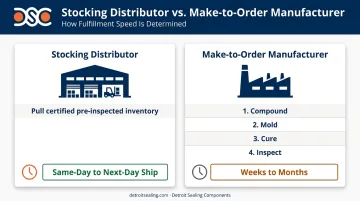
Most procurement teams don't confirm which model applies until lead time is already accumulating against a maintenance or production deadline.
Why Aerospace Seals Take Longer Than Industrial Seals
Standard industrial seals are often commodity items pulled off a shelf. Aerospace seals carry additional layers:
- Material traceability — lot control, cure date tracking, shelf-life verification
- Compound qualification — not every rubber grade meets aerospace AMS or MIL specs
- Compliance documentation — certifications must accompany the part to installation
- Receiving release time — quarantine, inspection, and document review add time even after delivery
Reducing lead time means compressing all of these stages — not just the shipping leg.
Why Aerospace Seal Lead Times Are Often Longer Than Expected
The Compound Qualification Problem
Aerospace seals aren't made from generic rubber. Each application demands a compound rated for specific temperature ranges, fluid exposures, and pressure profiles:
- FKM (Viton-class) — fuel systems and high-temperature engine applications, governed by SAE AMS7276
- FFKM — extreme-temperature, chemically aggressive environments, per SAE AMS7257
- Fluorosilicone (FVMQ) — oil and fuel exposure, per MIL-DTL-25988
- Silicone — broad temperature range, but note that AMS3304J explicitly excludes silicone from aerospace O-ring and compression seal applications; AMS7268 is the correct spec for those uses
The DLA lists AMS7276 FKM as a Non-government QPL item, meaning buyers need to verify QPL or drawing-approved material status before placing an order. That verification step is routinely skipped until an emergency — and by then, days are already lost before sourcing even begins.
The Documentation Burden
Aerospace buyers don't just need a seal. They need a seal with a paper trail. Finding a supplier who can produce material certifications, lot traceability records, and conformity documentation on short notice is genuinely difficult. Specialty compounds with limited qualified sources make that search even narrower.
Custom Geometry and Non-Standard Profiles
Many aerospace sealing applications involve profiles that can't be pulled from a standard O-ring inventory. Custom-molded seals require several steps before they ship:
- Tooling fabrication or verification
- Molding cycles and post-cure time
- Dimensional and material inspection
Without pre-existing tooling or an established compound library, that production sequence can add weeks to an already tight schedule.
Supplier Concentration Risk
The Aerospace Industries Association identifies single points of failure as a core supply chain vulnerability, noting that qualification cost and time limit how easily buyers can diversify sources. When a primary vendor is backlogged, there's often no pre-approved backup — and building one under pressure takes far longer than doing it in advance.
MRO Unpredictability
IATA defines unplanned maintenance as work that cannot be anticipated with less than one to three days' notice. That reactive pattern — discover the problem, then start sourcing — puts procurement teams in emergency mode for parts that could have been stocked or pre-sourced months earlier.
The Real Cost of Delayed Aerospace Seal Deliveries
A grounded aircraft costs up to $150,000/hour, according to IAG Cargo estimates. A half-day wait on a single missing seal can generate six-figure exposure before anyone finds an alternative supplier.
At scale, the numbers are worse. IATA estimates that maintenance-related schedule impacts cost the industry roughly $30 billion per year. Better parts visibility alone can cut AOG incidents and recovery costs by 10%.
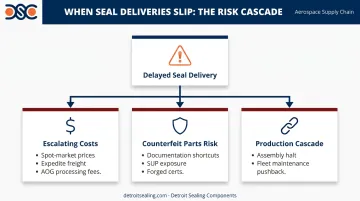
Beyond the headline numbers, delayed seals create several compounding problems:
- Spot-market prices, expedited freight fees, and AOG processing charges compound quickly — Boeing charges AOG processing fees on top of part cost, so emergency sourcing is never just the part price.
- Rushed procurement opens the door to undocumented parts. The FAA's Suspected Unapproved Parts (SUP) program exists precisely because pressure to source fast creates shortcuts. EASA warns that unlawfully removed parts often reenter the supply chain with forged documentation. Bypassing traceability trades one problem for a worse one.
- One missing seal can halt an entire assembly line or push back a scheduled maintenance window for a full fleet — the single-component delay rarely stays contained.
Proven Strategies to Reduce Aerospace Seal Lead Times
Prioritize Stocking Distributors Over Make-to-Order Suppliers
The fastest path to a certified seal is a distributor who already has it on a shelf. Stocking distributors hold pre-manufactured, pre-inspected inventory and can ship when a make-to-order supplier is still pulling raw material.
When evaluating a stocking distributor's inventory depth, look for:
- Breadth of rubber compounds across aerospace-relevant types (FKM, FFKM, EPDM, fluorosilicone)
- Range of standard geometries matching common aerospace profiles
- Lot-traceable stock with documentation ready at time of shipment
Detroit Sealing Components (DSC) maintains broad compound inventory across all major rubber types — including FKM, FFKM, EPDM, and silicone — and operates from a warehouse in Plymouth, Michigan, near major shipping lanes for fast nationwide delivery.
Plan for Demand Volatility with Safety Stock
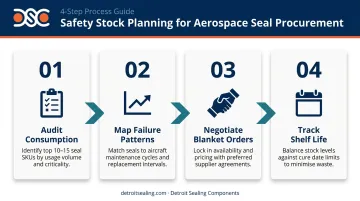
Reactive purchasing is the most expensive procurement strategy in aerospace. A better model:
- Audit historical seal consumption — identify the 10–15 seals used most frequently across maintenance intervals
- Map failure patterns — certain aircraft types and systems have predictable seal replacement cycles
- Negotiate blanket orders or stocking agreements — lock in availability and pricing before demand spikes
- Track shelf life actively — FAA AC 20-154A requires procedures for shelf-life materials; balance stock levels against cure date limits
Procurement teams that forward-purchase critical consumables ahead of demand spikes consistently maintain operational continuity — those waiting for shortages to materialize face avoidable AOG exposure.
Qualify Multiple Suppliers Before You Have an Emergency
Pre-qualification is the most underused tool in aerospace seal procurement. Most buyers have one approved vendor per part number. When that vendor is backlogged, they have no fallback.
Build an approved alternate matrix that covers:
- At least two to three suppliers per critical seal SKU
- Verified documentation capabilities (not just catalog listings)
- Confirmed compound range and QPL or OEM approval status
- Lead time commitments in writing
Do this in a routine procurement cycle, not during an AOG event.
Leverage Distributors with Custom Capability for Urgent Non-Standards
When a required seal isn't a standard geometry, the reflex assumption is long lead time. That assumption only holds when a distributor has no existing tooling — and the right partner usually does.
DSC's computer-aided design and finite element analysis capabilities allow custom seal parameters to be developed and validated quickly, using existing tooling infrastructure and access to hundreds of pre-qualified compounds. This compresses the custom development cycle compared to going directly to a manufacturer starting from bare tooling.
If a compound doesn't exist for a specific application, DSC's ISO 17025 accredited lab can custom develop and test it — delivering both speed and material confidence in the same cycle.
What to Look for in a Fast-Delivery Aerospace Seal Supplier
Fast delivery only matters if the seals that arrive are certifiably correct. Evaluate any supplier on both speed and compliance using this checklist:
| Criterion | What to Ask |
|---|---|
| Inventory depth | Do they stock, or just list? Can they ship today? |
| Documentation readiness | Can they provide lot traceability and certs at time of shipment? |
| Compound range | Do they cover FKM, FFKM, EPDM, fluorosilicone across aerospace specs? |
| Custom capability | Can they handle non-standard geometries without months of tooling delay? |
| Lab accreditation | Is their ISO 17025 scope relevant to the tests required by your AMS or MIL spec? |
On that last point: ISO 17025 accreditation matters, but scope is everything. A supplier whose accredited lab covers the specific tests required by AMS7276 or AMS7257 can validate compound performance. That means documented material confidence ships with the parts — no waiting on third-party test results after delivery.
When evaluating options, ask for sample documentation upfront. A supplier confident in their process will share a spec cert or lot traceability record before you place the first order.
Frequently Asked Questions
What is the meaning of reduced lead time?
Reduced lead time means shortening the total elapsed time from order placement to receipt of a ready-to-install part. In aerospace seals, that includes not just shipping but also material qualification, documentation verification, and compliant receiving release — the full cycle to an airworthy component.
How can lead time be reduced for aerospace seals?
Four approaches consistently deliver results:
- Source from stocking distributors with certified, lot-traceable inventory
- Maintain safety stock on high-frequency seal SKUs
- Pre-qualify multiple suppliers before an emergency occurs
- Work with distributors who handle standard and custom profiles without extended tooling cycles
What rubber compounds are commonly used in aerospace seals?
The most common compounds, by application:
- FKM/Viton — fuel systems and high-temperature use (AMS7276)
- FFKM — extreme-temperature, chemically aggressive environments (AMS7257)
- Fluorosilicone — oil and fuel exposure (MIL-DTL-25988)
- Silicone — broad temperature range (AMS7268 governs aerospace O-ring use)
Compound selection directly affects both performance and sourcing lead time.
What certifications should an aerospace seal supplier have?
Prioritize suppliers with AS9100-aligned quality processes, material certifications with lot traceability at shipment, and ISO 17025 lab accreditation covering relevant AMS or MIL specifications. QPL or OEM approval for controlled compounds is also critical.
What is the difference between standard and custom aerospace seals in terms of lead time?
Standard O-rings and seal profiles can ship same-day or next-day from a stocking distributor. Custom-molded seals require tooling and molding cycles — but distributors with pre-existing tooling libraries, design capability, and pre-qualified compounds can compress that custom development timeline significantly.
How does a stocking distributor differ from a direct manufacturer for aerospace seals?
Stocking distributors hold pre-manufactured, inspected inventory and ship immediately. Manufacturers produce to order, introducing production lead time even for simple configurations. For urgent aerospace requirements, a stocking distributor with broad compound coverage is the faster, lower-risk path.