The good news: aerospace-grade sealing performance and cost optimization are not mutually exclusive. The key is matching seal type, material, and compliance tier precisely to what each application actually demands — rather than defaulting to the most exotic option across the board.
This article covers the environmental demands aerospace seals must survive, the main seal types and where they're used, how to use material selection as a cost lever, how to navigate compliance standards without over-engineering, and how to evaluate seals on total cost of ownership rather than unit price.
Key Takeaways
- Aerospace seals operate across cryogenic temperatures, pressures up to 8,000 psi, and aggressive chemical environments — failure consequences are severe
- O-rings, backup rings, rod seals, and piston seals each serve distinct roles — correct type selection is the foundation of cost optimization
- Material selection — NBR, EPDM, FKM, PTFE, PEEK — is the primary driver of both performance ceiling and unit cost
- Applying the right compliance standard for each application tier (not the most stringent one universally) avoids unnecessary qualification overhead
- Total cost of ownership, not unit price, is the correct metric — one avoided maintenance event typically offsets a higher seal cost
The Extreme Demands Aerospace Seals Must Meet
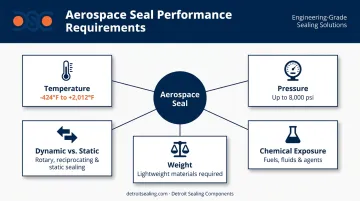
Aerospace seals don't operate in controlled conditions. They face simultaneous extremes — thermal, mechanical, and chemical — where any compromise in sealing integrity has direct operational consequences.
Temperature
The thermal range is enormous. Cryogenic propellant systems in launch vehicles operate as low as -424°F/-253°C (liquid hydrogen), where conventional elastomer O-rings become unsuitable. At the other extreme, engine compartment seals must maintain integrity at temperatures up to +608°F/+320°C using perfluoroelastomer compounds, with fire-control-rated reinforced seals tested to +2,012°F/+1,100°C, according to Trelleborg's aerospace engineering catalog.
Pressure
Aircraft hydraulic systems push seals hard. Flight control systems operate at 5,000 psi, while actuation seals are engineered for pressures up to 8,000 psi. At those levels, elastomeric O-rings require anti-extrusion backup rings; SAE AS4716 specifically addresses this requirement for pressures above 1,500 psi.
Chemical Exposure
Seals contact hydraulic fluids, aviation fuels, lubricants, de-icing agents, and cleaning compounds over their service life. Chemical incompatibility causes swelling, hardening, or delamination — each a precursor to seal failure. Material selection must account for every fluid a seal will encounter, not just the operating temperatures it must survive.
Weight
Every component in an aircraft must justify its presence by weight. Airbus data indicates that a 1% reduction in aircraft weight produces approximately a 0.75% reduction in fuel consumption at the airframe level — context that makes lightweight seal material selection a legitimate engineering and financial consideration.
Dynamic vs. Static Demands
Static seals hold stationary joints and typically experience lower wear rates. Dynamic seals — rod seals, piston seals, rotary lip seals — accommodate continuous motion under pressure, which accelerates wear and demands tighter geometric tolerances and higher-performance materials from the outset.
Meeting all five of these demands simultaneously is what makes aerospace seal specification complex. The challenge — and the opportunity — is that the right material and geometry choices address multiple demands at once, which is where cost optimization becomes possible without compromising performance.
Common Types of Aerospace Seals and Their Applications
Static Seals
O-rings and gaskets are the workhorses of static sealing. O-rings dimensioned to SAE AS568D are used across fuel, hydraulic, and pneumatic systems to seal flanges, fittings, and panel joints. When correctly specified by material and groove geometry, they're among the most cost-effective sealing formats available.
Backup rings (per SAE AS5860C, specifying scarf-cut PTFE retainers) prevent O-ring extrusion under high pressure. In hydraulic actuator assemblies where pressures exceed 1,500 psi, backup rings are typically required alongside the primary O-ring — skipping them is a common and costly error.
Dynamic Seals
Rod seals and piston seals are critical components in hydraulic cylinders and actuators used in landing gear and flight control systems. Each type handles a distinct function:
- Rod seals prevent hydraulic fluid from escaping the cylinder along the reciprocating rod
- Piston seals prevent bypass across the piston face, maintaining the pressure differential that generates force
A 2022 Engineering Failure Analysis study identified eight distinct failure mechanisms in reciprocating airplane actuator seals — a reminder that seal selection and specification here carry real consequences.
Custom-molded seals address geometries where standard catalog seals can't deliver adequate contact geometry or sealing performance — non-standard inner diameters, complex cross-sections, or assemblies requiring specific parting line locations. Detroit Sealing Components works directly with engineers using CAD and finite element analysis to specify these geometries, then sources custom-molded components validated against customer application requirements.
Material Selection: The Key to Advanced Performance at Optimized Cost
Material choice determines both performance ceiling and unit cost. The goal is matching capability to application demand rather than automatically specifying the most expensive compound where a proven, lower-cost option will perform reliably.
Standard Elastomers
| Material | Temperature Range | Best For | Limitation |
|---|---|---|---|
| NBR (Nitrile) | -34°C to +121°C | Petroleum oils, mineral hydraulic fluids | Not suited for phosphate ester fluids or ozone exposure |
| EPDM | -45°C to +150°C | Phosphate ester fluids (Skydrol 500/7000) | Incompatible with petroleum oils or jet fuels |
| Silicone (VMQ) | -50°C to +175°C | Wide temperature range applications | Low tensile/tear strength; poor for dynamic service |
| Fluorosilicone (FVMQ) | -50°C to +175°C | Fuel and mineral oil exposure with low-temp needs | Not suitable for phosphate ester fluids |
These compounds represent the most cost-accessible tier. For many static sealing applications (fuel system fittings, environmental system joints, pneumatic connections) a correctly specified NBR or EPDM O-ring delivers reliable service life without premium material cost.
FKM (Fluorocarbon / Viton)
FKM operates from -20°C to +200°C, with selected grades reaching -35°C and short-term exposure to +230°C. It handles mineral oils, greases, and jet fuels reliably, which makes it the standard choice for engine bay and high-performance hydraulic applications. SAE AMS7276J and AMS7259 both cover FKM sealing rings for high-temperature, fluid-resistant service.
FKM costs more than standard elastomers, but extended service intervals in demanding applications typically justify the premium in total cost terms.
PTFE and PEEK
PTFE's broad chemical resistance makes it standard in backup rings (AS5860C) and dynamic sealing applications where low friction matters. PEEK maintains structural integrity at continuous use temperatures up to 260°C/500°F (melting point ~343°C), according to Greene Tweed material data, making it suited for the most thermally and chemically aggressive dynamic environments.
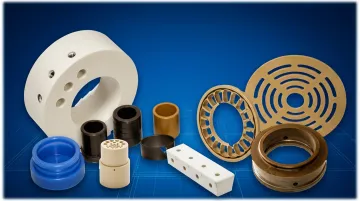
Both materials carry higher unit costs. Their value case rests on longevity in applications where standard elastomers would fail prematurely.
Composite and Custom Compounds
Some applications require blends: base polymers combined with glass fiber, carbon, or bronze fillers to achieve specific hardness, conductivity, or wear resistance. A broad compound library is a direct cost optimization tool. It prevents single-source dependency and allows specification of the most economical compound that meets performance requirements.
DSC's compound access spans hundreds of formulations across all major rubber types. Key capabilities include:
- Specification of the lowest-cost qualifying compound across NBR, EPDM, FKM, PTFE, and PEEK families
- Custom formulation development and validation through DSC's ISO 17025 accredited lab
- Compound qualification support without customers needing to build internal testing infrastructure
Navigating Aerospace Compliance Standards Without Overspending
The Major Standards Families
| Standard | Scope |
|---|---|
| AS9100D | Supplier quality management system — applies to supplier qualification, not seal geometry |
| SAE AS568D | Dimensional standard for O-ring inside diameters, cross-sections, and dash numbers |
| SAE AS4716 | Gland design for elastomeric O-ring seals above 1,500 psi with anti-extrusion rings |
| SAE AS5860C | PTFE scarf-cut backup rings for hydraulic/pneumatic anti-extrusion use |
| AMS7276J / AMS7259 | FKM sealing ring specs — high-temperature, fluid-resistant, low compression set |
| AMS7257 | FFKM sealing rings for the highest temperature and fluid resistance demands |
| MIL-DTL-5516 | Hydraulic packings for petroleum-based MIL-PRF-5606 fluid, -65°F to +160°F |
MIL-DTL-5593 is not an O-ring standard. DLA documentation identifies it as a specification for aircraft low-pressure flexible hose. Citing it as a seal compliance standard is a common error with procurement consequences.
Matching Standard to Application Tier
Not every system requires the most stringent specification. A seal in a cabin environmental control system has different compliance requirements than one in an engine fuel circuit or rocket propulsion assembly. Applying engine-tier specifications to lower-criticality applications adds unnecessary qualification overhead — documentation, testing, and traceability burdens — without improving operational safety.
The practical discipline is straightforward: identify each application's criticality tier and apply the governing standard for that environment. Verify with a supplier who understands which specifications actually apply across compound type, fluid contact, and operating temperature.
DSC provides material certifications and test documentation through its ISO 17025 accredited lab to support customers' AS9100D qualification processes — so customers avoid duplicating that testing infrastructure themselves.
Total Cost of Ownership: Why the Cheapest Seal Often Costs the Most
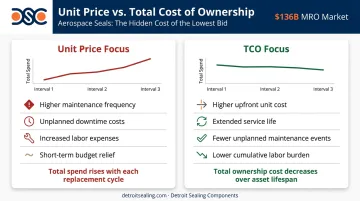
Unit price is the wrong metric for aerospace seal procurement. Total cost of ownership (TCO) includes:
- Acquisition cost
- Installation labor
- Maintenance interval frequency
- Replacement cost per event
- Cost of unplanned downtime
A seal priced 30–50% higher per unit can easily deliver lower TCO if it doubles service life or eliminates one unplanned maintenance event annually.
The Maintenance Cost Context
Oliver Wyman's 2026 MRO market forecast projects global MRO demand at $136 billion in 2025, growing to nearly $193 billion by decade end. IATA defines unplanned technical grounding (UTG) as aircraft downtime caused by maintenance that couldn't be anticipated — with an example benchmark of 5 days per aircraft per year over a 12-year service life. Any seal failure that triggers a UTG event carries labor, parts expediting, and out-of-service costs that dwarf the cost difference between a standard and premium seal.
Where Cost Optimization Works Without TCO Penalty
Not every application warrants a premium seal. Static sealing in non-critical systems often performs equivalently with a correctly specified NBR or EPDM O-ring versus an FKM alternative. Common examples include:
- Environmental control joints
- Cabin pneumatic fittings
- Low-pressure fluid connections
The discipline is knowing where the performance delta exists and where it doesn't.
Sourcing from a distributor with deep inventory across standard seal formats and materials directly supports this kind of specification discipline. Detroit Sealing Components stocks precision molded rubber goods nationwide, which reduces lead time delays and expedite fees that inflate acquisition costs when seals are sourced reactively on an as-needed basis.
Frequently Asked Questions
What are the basic types of seals used in aerospace applications?
Aerospace seals divide into static and dynamic categories. Static seals — O-rings, gaskets, and backup rings — hold stationary joints in fuel, hydraulic, and pneumatic systems. Dynamic seals — rod seals, piston seals, and rotary lip seals — accommodate continuous motion in actuators, landing gear, and rotating assemblies. Application type determines which category applies.
Which seal type prevents fluid leakage in hydraulic actuators?
Rod seals prevent hydraulic fluid from escaping the cylinder along a reciprocating actuator rod, while piston seals prevent fluid bypass across the piston face. Both are critical in aircraft landing gear and flight control actuators.
What materials are most commonly used in aerospace seals?
Common choices include NBR and EPDM for standard static applications, FKM for engine bay and high-pressure hydraulic service, and PTFE or PEEK for high-temperature dynamic environments. Selection should match the fluid, temperature, and pressure of each specific application.
How do compliance standards affect aerospace seal procurement costs?
Matching the right standard tier to each application avoids unnecessary qualification and documentation costs. Engine-zone seals may require AMS-level fluoroelastomer specs, while lower-criticality hydraulic packings align with MIL-DTL-5516 — applying the stricter standard everywhere adds cost without adding value.
What is the difference between a gasket and a seal?
Gaskets are static components compressed between two stationary surfaces — flanges, panel joints, fittings — to prevent leakage at fixed interfaces. Seals are designed to maintain integrity during relative motion, such as a reciprocating piston rod or rotating shaft. The distinction drives different material specifications, geometric tolerances, and qualification requirements.