O-rings are the default seal in a lot of equipment until they aren’t. When you’re dealing with motion, pressure spikes, aggressive media, or contamination, an O-ring can be the wrong starting point, even if the size and material look “close.”
This guide gives you a fast way to choose the right O-ring alternative based on what actually drives failure: how the joint moves (or doesn’t), how pressure behaves, what fluids/cleaners touch the seal, and whether debris is getting into the interface.
Use the decision table to match your situation to the seal family that’s designed to survive it without trial-and-error swaps.
Key Takeaways
Start with material compatibility: media + cleaners + temperature profile (including peaks) decide what elastomers are even viable.
Then match the joint: static face → gasket; static groove → O-ring/X-ring; moving interface → dynamic seal family.
Spikes + gaps need support: extrusion control (back-up rings / pressure-rated designs) beats “tougher rubber.”
Motion needs wear control: lubrication + surface + seal style drive life more than compound alone.
Contamination changes everything: wipers/excluders often extend life more than swapping seal materials.
Note: This is general guidance, confirm final design against OEM specifications, ISO 3601 / AS568 (as applicable), and your application requirements.
Material fit check first (media + cleaners + temperature)
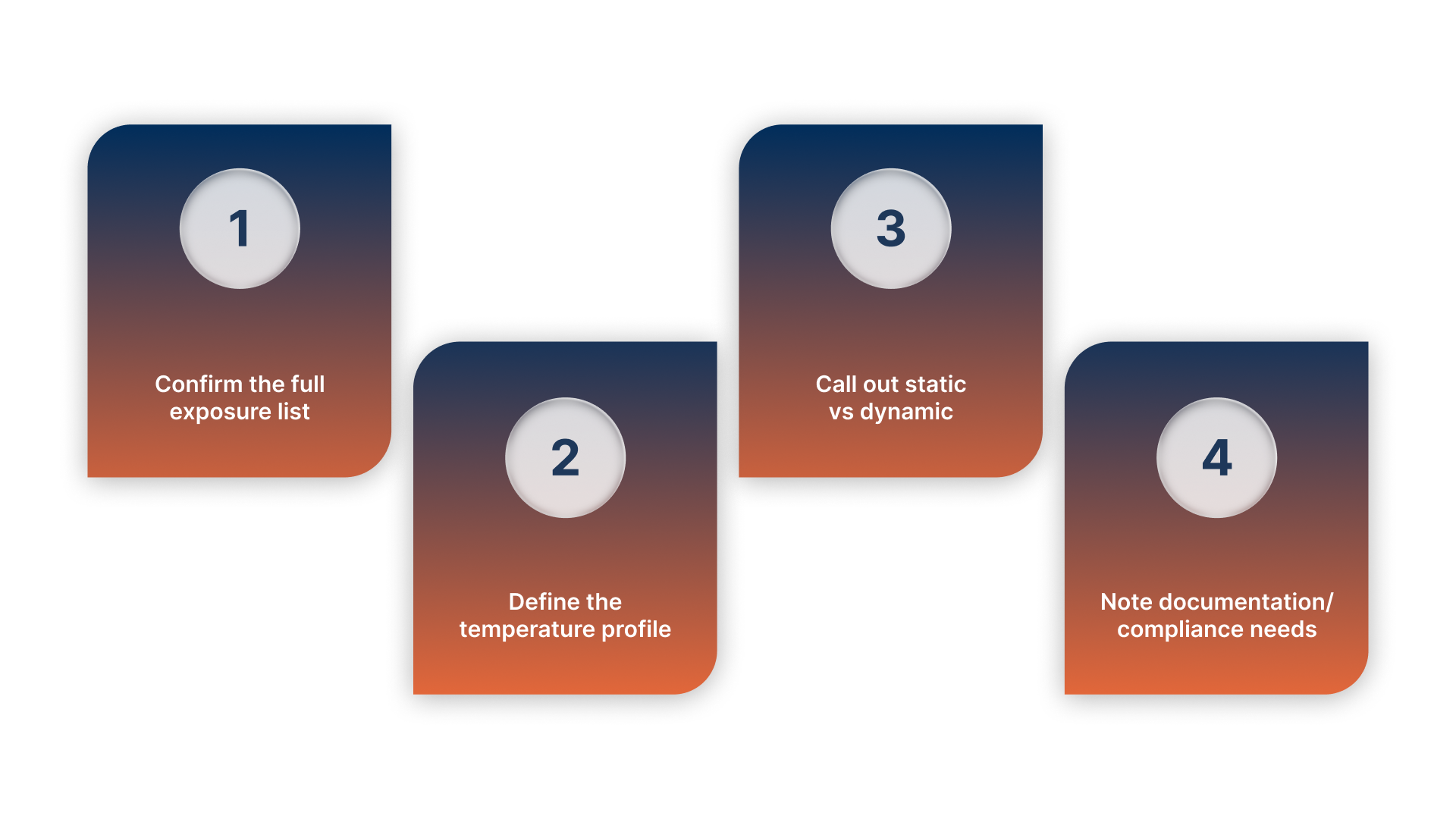
Material selection is a screening checklist; you’re confirming whether the compound will survive the real exposure and duty cycle.
If the material family isn’t compatible, don’t move on to geometry; switch materials first.
List everything that touches the seal (process media + additives + cleaners/CIP)
Define temperature profile (normal, peaks, time-at-peak)
Note any special constraints (food/contact, documentation)
If unknown chemistry: pause and verify compatibility before choosing a seal type
Material compatibility narrows the viable options. Joint geometry, motion, and pressure behavior determine which seal style will actually survive.
Choose the right O-ring alternative in 60 seconds
Before you jump to a new seal type, lock these five inputs. They’re the fastest way to narrow to the right alternative (and avoid “almost worked” swaps).
Inputs you need
Hardware/joint type: flat face vs gland/groove (and any groove details if you have them)
Motion (static/reciprocating/rotary)
Pressure behavior (steady vs spikes) + any clearance gap risk
Contamination exposure (dust/grit/slurry/washdown)
Leakage tolerance + serviceability (allowable weep, downtime, open/close frequency)
With material viability confirmed and duty defined, the seal family is usually a straightforward match.
Decision table, best O-ring alternative by situation
Use this table to match your joint type + duty cycle to the seal style that’s actually built for it, so you’re not forcing an O-ring into a job where it predictably fails.
Situation | Best alternative | Why it works | What to verify |
|---|---|---|---|
Static flange/cover, surface variation | Gasket | Flat-face compression can tolerate minor face variation better than forcing a round seal | Flange flatness, surface finish, bolt load/torque pattern, gasket thickness |
Static radial groove, but repeat leaks | Fix the gland + correct O-ring (or redesign to gasket/dynamic seal if no gland) | Most “repeat leaks” here are groove/squeeze/finish issues, not the seal “type.” | Groove dimensions/squeeze, stretch, surface finish, damage/sharp edges, assembly cuts |
Reciprocating with twist/spiral/uneven wear | X-ring / quad-ring | More stable profile helps resist rolling/twisting in motion | Groove compatibility, lubrication, side-load/misalignment, surface finish |
High pressure and/or spikes with gap risk | O-ring + back-up ring | Back-up ring blocks extrusion into clearance gaps (the usual blowout driver) | Extrusion gap under load, spike magnitude, pressure direction (backup placement) |
High-cycle cylinders/actuators | Hydraulic seal set (rod/piston + wiper as needed) | Purpose-built for wear control + leakage control under cycle life and contamination | Rod/piston finish, alignment/runout, contamination level, seal-stack design |
Rotary shaft sealing (continuous rotation) | Rotary lip seal (O-ring rarely primary) | Designed for speed/runout/heat—where O-rings typically struggle | Shaft finish, runout, surface speed, lubrication type/availability, temperature |
Abrasives/washdown contamination | Wiper/excluder + primary seal | Keeps debris out so the primary seal survives (often the real failure driver) | Entry path, placement, exposure type (abrasive vs washdown), stack order |
Tight leakage control / high speed / mixed duty | Engineered solution (e.g., mechanical seal / OEM design) | Some duties need a different sealing principle, not a different elastomer shape | Duty cycle, allowable leakage, heat management, hardware constraints, OEM guidance |
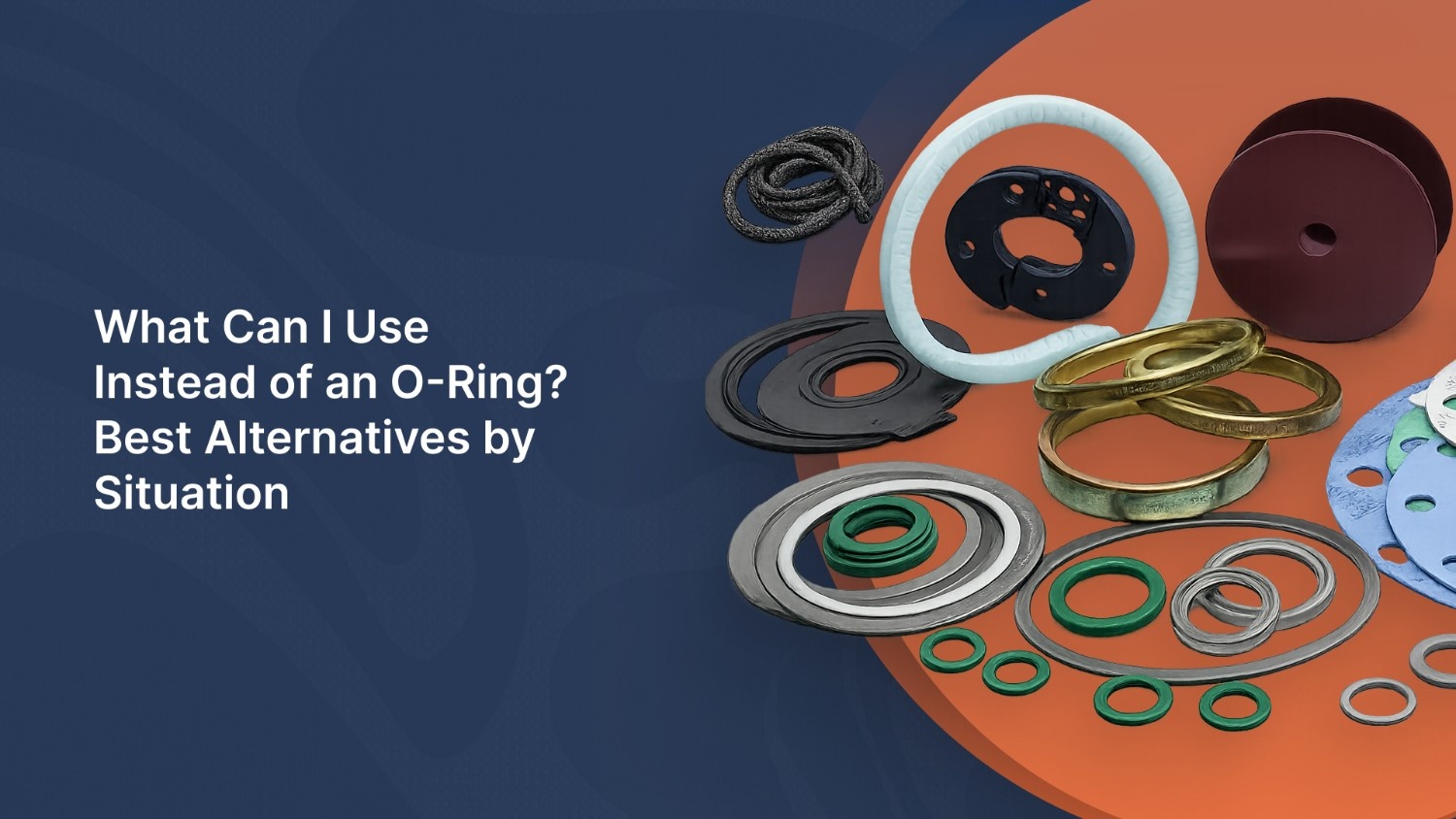
What these alternatives are
Gasket: flat-face compression seal for covers/flanges.
X-ring / quad-ring: more stable profile than an O-ring in reciprocating motion.
Back-up ring: anti-extrusion support used with O-rings under pressure/clearance risk.
Hydraulic seal set: dynamic seals built for wear + leakage control in cylinders/actuators.
Rotary lip seal: a seal designed for rotation, speed, runout, and heat at the shaft.
Wiper/excluder: debris barrier that protects the primary seal from contamination.
Repeat failures usually trace back to a geometry mismatch or an unaddressed duty driver (motion, spikes, gaps, or contamination).
Common swap mistakes (and what to do instead)
Most “O-ring alternative” decisions go wrong in the swap itself, using the right idea (stop the leak) with the wrong seal geometry for the joint.
Forcing a groove-style seal into hardware that wasn’t designed for it
What happens: inconsistent squeeze, pinching, shifting, repeated leaks.
Do instead: use a gasket on flat-face joints, or machine/verify a proper gland before using O-rings/X-rings.
Using “thicker = better” to stop leaks
What happens: over-squeeze, assembly cuts, higher friction/heat in motion, premature wear.
Do instead: match the correct cross-section for the gland and verify the gland depth/support rather than upsizing by feel.
Treating pressure spikes/clearance as a material problem
What happens: extrusion/nibbling (“chewed edge”), blowouts during spikes, even with “good” compounds.
Do instead: control extrusion with hardware support (tight clearance) or add a back-up ring / pressure-rated seal setup.
Using a static sealing approach on a moving interface
What happens: the seal becomes a wear surface; friction and heat dominate; leaks return quickly.
Do instead: move to a dynamic seal family (hydraulic seal set for reciprocating, rotary lip seal for shafts) and add exclusion (wiper/excluder) if contamination is present.
The wear pattern usually points to the failure driver faster than the part number does.
Fast failure tells: what you see → what it means → first check
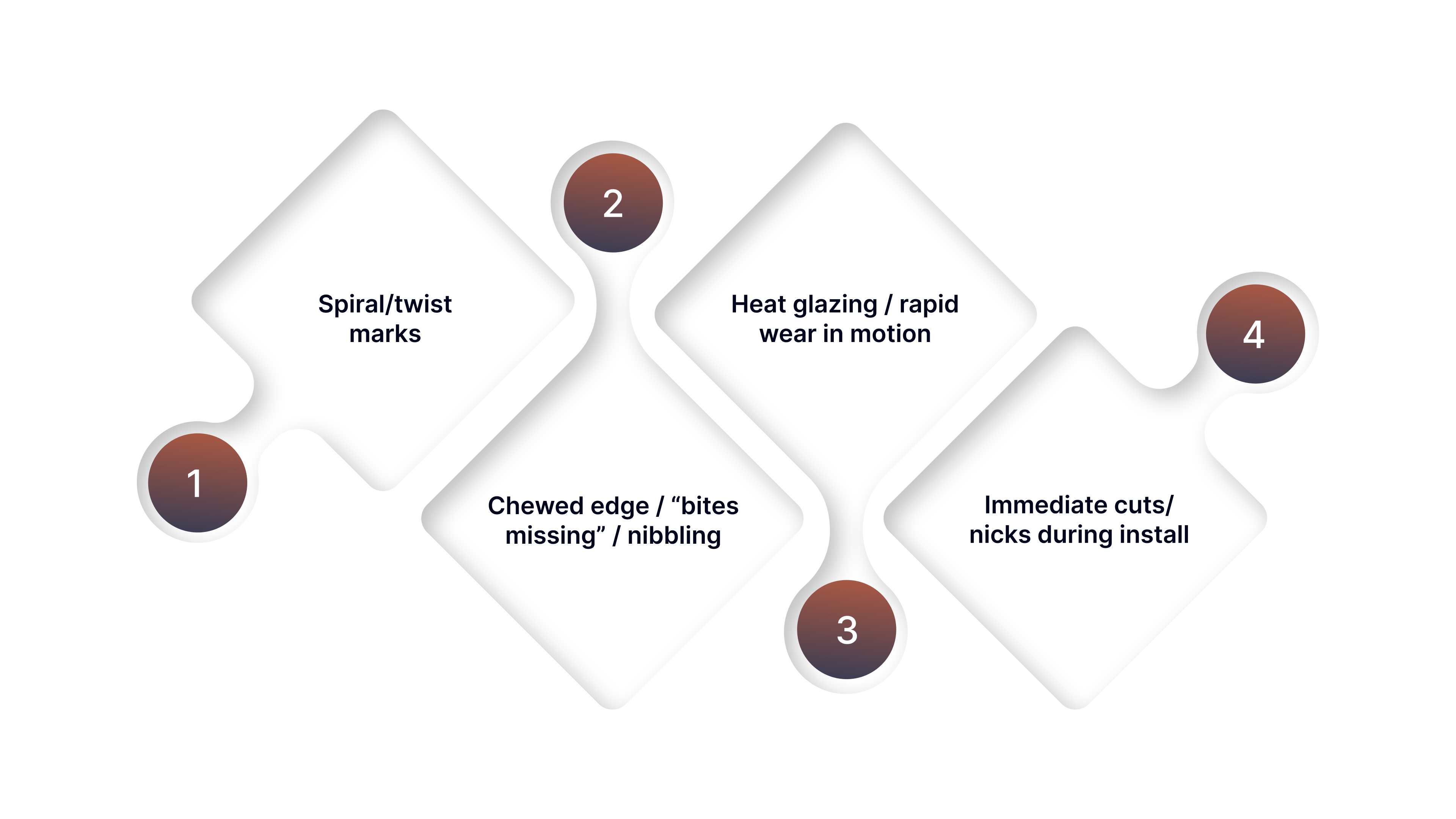
These quick “tells” help you identify whether the root issue is twist/instability, extrusion support, friction/heat, or installation damage, and what to change first.
Spiral/twist marks (usually in reciprocating motion)
Likely cause: the seal is rolling or twisting under friction/side load.
First move: step up to an X-ring/quad-ring and verify lubrication, surface finish, and side-load/misalignment.
Chewed edge / “bites missing” / nibbling
Likely cause: extrusion into a clearance gap, often made worse by pressure spikes.
First move: add a back-up ring, then confirm gap size under load, spike magnitude, and pressure direction (backup placement matters).
Heat glazing / rapid wear in motion
Likely cause: friction heat + wear dominating (too much squeeze, poor lube, surface mismatch, misalignment).
First move: reduce friction drivers (lubrication plan + compatibility, surface condition, alignment/runout) and consider a dynamic seal family if duty is high.
Immediate cuts/nicks during install
Likely cause: sharp edges/threads, poor lead-in, or assembly method damage (not “wrong material”).
First move: add/verify lead-in chamfers, deburr edges, protect past threads/ports, and use a compatible assembly lubricant before changing size/material.
Match the symptom to the failure driver, then make the first change most likely to move the outcome: stability, extrusion support, friction control, or installation fixes.
Dynamic sealing options that Detroit Sealing Components supports
When the decision comes down to stability in motion, extrusion control, wear life, or contamination, DSC can support the seal families and add-ons that solve the actual failure driver, not just the symptom.
Stability in reciprocating motion (twist/rolling): DSC supplies O-rings and X-rings/quad-rings, a common step-up when standard O-rings roll, twist, or wear unevenly, and sealing becomes inconsistent.
Extrusion control under spikes (gap + pressure): DSC supplies back-up rings to support O-rings when clearance gaps and pressure spikes create nibbling/extrusion—cases where squeeze alone won’t hold up.
High-duty motion (cylinders/actuators): DSC supplies hydraulic/dynamic seals for applications that need wear control and tighter leakage control under cycle life, side-load, or higher PV conditions.
Contamination protection (abrasives/washdown): DSC supplies wipers, V-seals, and excluders to keep debris out and protect the primary seal, often the difference between short life and stable runtime.
Share your motion type, pressure (and spikes), media + temperature (including any cleaners/CIP), and any groove/gland details, and Detroit Sealing Components can point you to the most reliable seal family + support strategy for your application.
Conclusion
Choosing an O-ring alternative comes down to five checks you can run fast: static vs dynamic motion, pressure spikes + clearance risk, media/cleaners + temperature profile, contamination exposure, and leakage/serviceability needs.
Use those inputs to pick the right seal family (gasket, X-ring/quad-ring, back-up ring, hydraulic seal set, rotary lip seal, wiper/excluder), avoid the common swap mistakes, and let the wear pattern confirm the next step when it’s already failing.
With material viability confirmed and the right seal family selected, you avoid trial-and-error swaps and get a setup that survives real duty.
FAQs
What can I use instead of an O-ring?
Common alternatives include gaskets (flat-face joints), X-rings/quad-rings (reciprocating motion stability), O-rings with back-up rings (pressure spikes/extrusion risk), hydraulic seal sets (high-duty cylinders/actuators), rotary lip seals (continuous rotation), and wipers/excluders (contamination control). The right choice depends on motion, pressure behavior, and joint geometry.
When should I use a gasket instead of an O-ring?
Use a gasket when the joint is flat-face compression (covers, flanges, split housings) and doesn’t have a proper gland to control O-ring squeeze. Gaskets also tolerate minor surface variation better than trying to force a groove-style seal into a flat joint.
Are X-rings (quad-rings) better than O-rings?
They can be—in reciprocating motion, especially when you see rolling, twist/spiral marks, or uneven wear with an O-ring. X-rings/quad-rings are often used as a stability step-up, but they still require correct groove fit, surface finish, and lubrication.
What is a back-up ring, and when do I need one?
A back-up ring is an anti-extrusion support ring used with an O-ring to prevent the elastomer from being forced into a clearance gap. You typically need one when there’s high pressure and/or pressure spikes, elevated temperature softening, or any situation where extrusion/nibbling shows up at the seal edge.
Can I use an O-ring on a rotating shaft?
Sometimes, but it’s rarely the best primary seal for continuous rotation. Rotation is sensitive to surface speed, runout/misalignment, friction heat, and lubrication, which is why a rotary lip seal is commonly a more reliable choice. O-rings are more often used for static or limited-motion cases unless the design is specifically built for it.