Introduction
A single non-compliant gasket can trigger a product recall, a regulatory shutdown, or a pathogenic contamination event. The FDA Inspection Technical Guide No. 48 documents a real dairy inspection where finished products tested positive for pathogenic E. coli traced directly to deteriorated equipment gaskets. Physical contamination from degraded gasket material has similarly driven ground beef recalls — a reminder that seal failure is never just a maintenance problem.
The bigger problem is that the label "food grade" on a seal or gasket tells you almost nothing about its actual safety for your application. Seal material selection is a food safety decision — one that carries regulatory and liability weight beyond any engineering specification. Real compliance requires verified, compound-level documentation — not a marketing claim. This guide covers what FDA non-leaching compliance actually requires, which materials meet that standard, and how to verify supplier documentation before approving a component for food contact use.
Key Takeaways
- Every ingredient — base polymer and additives — must individually appear on the FDA White List (21 CFR Part 177); the finished compound isn't automatically compliant
- "Food grade," "FDA compliant," and "FDA approved" are distinct terms with different compliance implications
- Platinum-cured silicone produces fewer extractables than peroxide-cured silicone — curing method matters
- Silicone, EPDM, PTFE, and nitrile differ by temperature range, chemical resistance, and food type compatibility
- Always request a compound-level compliance certificate and extraction test data, not just a label
Why Non-Leaching Seals Matter More Than You Think
Why Seal Material Compliance Directly Affects Your Food Safety Risk
What Leaching Actually Means
When a rubber seal contacts food or beverage product — especially under heat, pressure, or cleaning chemical exposure — substances within the compound can migrate into the product. These extractables include:
- Plasticizers and processing aids
- Curing agents and vulcanization byproducts
- Antioxidants and stabilizers
- Fillers and colorants
The base polymer is rarely the problem. A seal made from an approved silicone backbone can still leach harmful substances if its additive package uses unregulated components. This is where most compliance failures originate.
Curing Method: The Detail Most Suppliers Skip
Peroxide-cured silicone uses organic peroxides as the vulcanization agent. These can leave reactive byproducts in the finished compound that may migrate under thermal or chemical stress. Platinum-cured silicone uses a catalytic reaction that produces a cleaner cure with fewer residual extractables.
This distinction rarely appears in standard product listings, yet it directly affects your regulatory compliance in dairy, beverage, and pharmaceutical processing. Specifying the wrong cure chemistry is one of the most common — and avoidable — sources of failed migration testing.
The Real Stakes
Those chemistry choices have real downstream consequences. A 2023 peer-reviewed review found that foreign materials caused roughly 1 in 10 food recalls over the prior two decades, with gaskets, seals, and conveyor components identified as potential extrinsic sources. Beyond physical contamination, chemical leaching from non-compliant seals can cause:
- Flavor and odor transfer into products
- Failed lab migration tests
- FDA citations during facility inspections
- Costly recalls and liability exposure
When a recall or citation occurs, the specification record determines who bears responsibility — making material selection a procurement and engineering decision with legal weight.
FDA Compliance Decoded: What the Regulations Actually Require
The White List and 21 CFR 177.2600
21 CFR Part 177, Section 177.2600 governs rubber articles intended for repeated food contact. It defines which polymers and adjuvant substances — accelerators, antioxidants, fillers, plasticizers, vulcanization agents — are permitted in the formulation.
Critical point: being on the White List applies to individual ingredients, not the finished compound. A compound assembled from multiple White List ingredients is not automatically compliant. Every additive in the formulation must independently qualify, and the finished article must pass extraction limit testing.
The extraction limits under 21 CFR 177.2600:
| Contact Type | Test Medium | Limit (first 7 hours) |
|---|---|---|
| Aqueous food contact | Distilled water | 20 mg/sq in |
| Fatty food contact | n-Hexane | 175 mg/sq in |
Cutting Through the Terminology
These terms are not interchangeable — but many suppliers use them as if they are:
- Food grade — The material's composition uses ingredients acceptable for food contact (no specific extraction testing implied)
- FDA compliant — The compound ingredients appear on applicable 21 CFR lists for the intended use
- FDA approved — No formal FDA meaning exists for commercial rubber compounds; don't use it in specs without a specific authorization reference
- Food contact substance — A substance that contacts food as part of packaging, manufacturing, or handling under 21 CFR
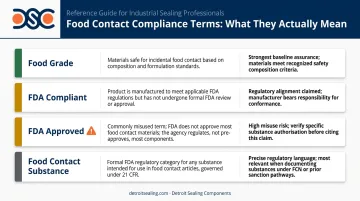
Misusing these terms in procurement specs creates real compliance gaps during audits.
Third-Party Verification: NSF/ANSI 51 and Beyond
Third-party certification closes the gap that terminology confusion opens. NSF/ANSI 51 covers materials used in commercial food equipment — and unlike self-declared FDA compliance, NSF independently tests the complete formulated product, not just the ingredient list. Certified products are searchable in the NSF Standard 051 directory, giving procurement teams a verifiable record to cite during audits.
Other certifications relevant to food-contact seals:
- EU Regulation 1935/2004 — Prohibits transfer of constituents to food in quantities that could endanger health or alter organoleptic characteristics; required for European market supply chains
- 3-A Sanitary Standard 18-03 — Covers rubber and rubber-like materials as product-contact surfaces in dairy and beverage equipment; 3-A's replacement parts certification program for seals and seal assemblies takes effect in 2026
Top FDA-Compliant Seal Materials: Leaching Profiles and Best-Fit Applications
Material selection requires balancing three factors simultaneously: extractable risk under actual process conditions, operating temperature range, and chemical compatibility with both the food product and cleaning agents.
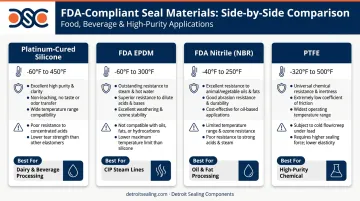
Platinum-Cured FDA Silicone
Silicone's inorganic Si-O backbone provides inherent chemical stability and low reactivity. Platinum-cured grades produce fewer residual extractables than peroxide-cured alternatives, making them the preferred choice for sensitive direct-contact applications.
- Temperature range: -60°C to approximately 210°C (-76°F to 410°F), with special grades to 230°C
- Strengths: Broad thermal range, steam resistance, sanitizer compatibility, excellent for dairy, beverage, and pharmaceutical processing
- Limitations: Not resistant to steam above 120°C (248°F), concentrated acids and alkalis, silicone oils, or aromatic mineral oils — request compound-specific data for your cleaning regime
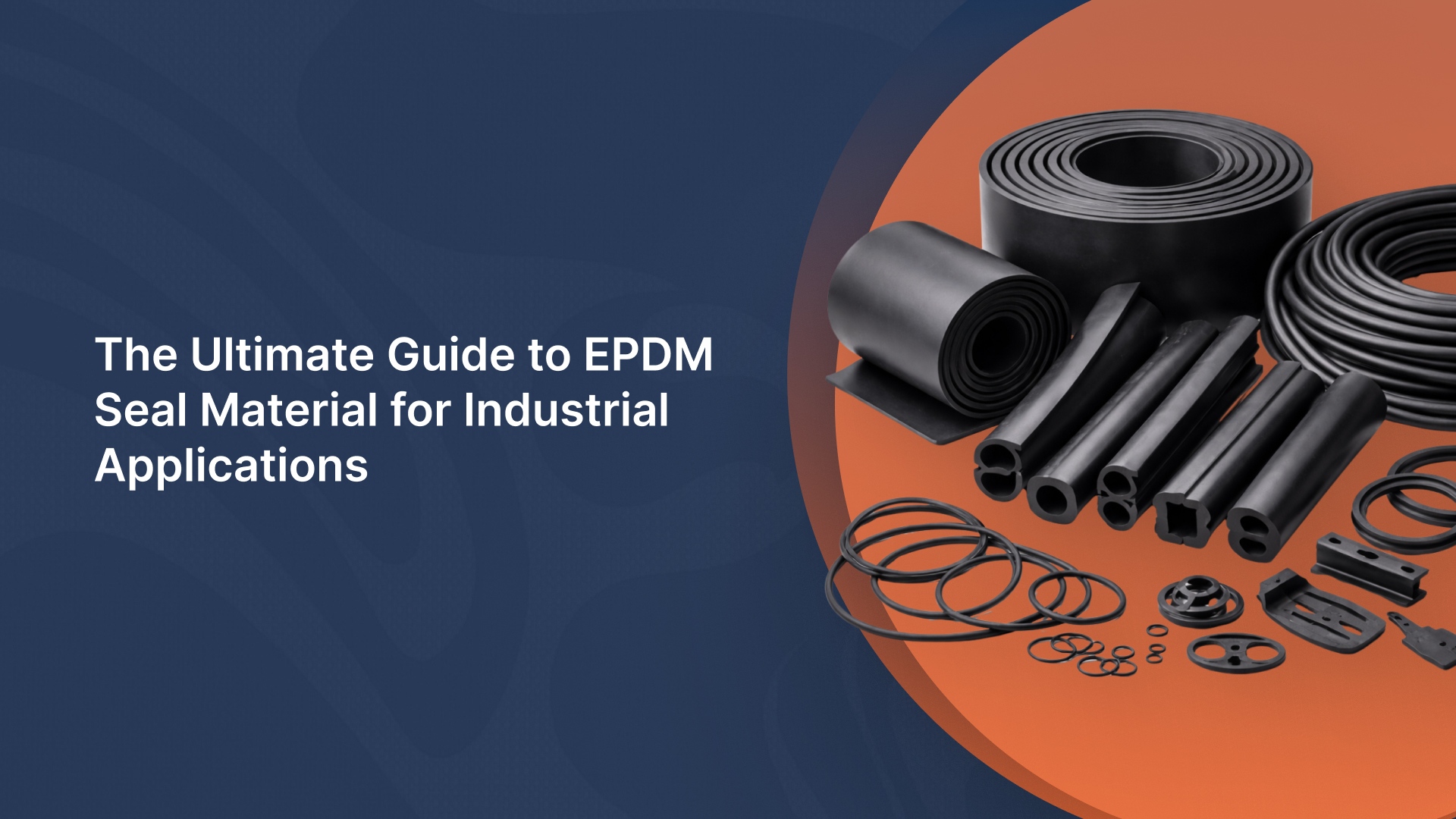
FDA EPDM
EPDM excels where hot water, steam, and oxidizing cleaning chemicals are the primary exposure. Its non-oil-based polymer structure resists swelling in water and dairy environments — a critical advantage in sanitary fittings and CIP/SIP lines.
- Temperature range: -45°C to +150°C (-49°F to 302°F), up to 180°C in water vapor
- Strengths: CIP/SIP compatible, hot water and steam resistant, widely used in sanitary fittings
- Limitations: Not suitable for oil-carrying food lines — EPDM degrades in contact with aliphatic, aromatic, and chlorinated hydrocarbons
DSC carries FDA-grade EPDM in standard and custom-molded configurations for sanitary fittings, with certifications including NSF 61, NSF 42, and FDA 177.2600 compliance.
FDA Nitrile (Buna-N)
FDA Nitrile (NBR) is the right material for oil- and fat-rich environments: meat processing lines, frying equipment, and oil-based food conveyance.
- Temperature range: Request compound-specific data sheet — varies by formulation
- Strengths: Resistant to mineral oils, greases, and waxes; effective where EPDM or silicone would swell or degrade
- Limitations: Not suited for hot water or steam applications
PTFE
PTFE offers the broadest chemical resistance of any seal material, covering acidic beverages, aggressive cleaning agents, and high-purity processing lines. Its service range runs from -200°C to +260°C.
- Temperature range: -200°C to +260°C (-328°F to 500°F)
- Strengths: Unmatched chemical resistance across nearly all food-contact environments
- Limitations: PTFE is not elastomeric. It requires an energizing component and different sealing design considerations — it cannot directly replace an O-ring without engineering review
Selecting the Right Non-Leaching Seal for Your Process
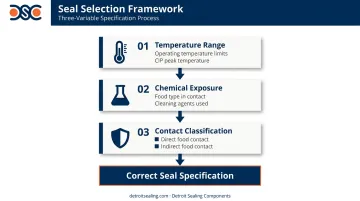
Three Variables Drive Every Decision
1. Temperature range Match the material to both normal operating temperatures and peak cleaning temperatures. CIP cycles often run hotter than the process itself — a seal rated for 150°F product contact may fail at the 180°F alkaline wash that follows.
2. Chemical exposure Identify all contact media:
- Food type: oil-rich, acid-rich, water-based, dairy
- Cleaning agents: chlorinated disinfectants, alkaline lye, acidic CIP, oxidizing agents, steam
3. Contact classification
- Direct food contact — the seal touches the food product; highest compliance standard applies
- Indirect food contact — incidental exposure only; potentially lower certification threshold, but always specify for the most demanding scenario present in the application
Avoid Both Over- and Under-Specifying
Defaulting to PTFE for every food contact application raises cost without adding safety where EPDM or silicone would perform equally well. Conversely, using standard peroxide-cured silicone where a platinum-cured grade is warranted creates extractable risk that doesn't show up until a lab test or audit catches it.
Getting this right requires a supplier with deep compound access and the engineering support to match material to application. DSC's library spans hundreds of compounds across silicone (VMQ), EPDM, NBR, and PTFE, giving food and beverage customers the range to specify precisely for their actual process conditions.
Custom geometries — gaskets, diaphragms, sanitary fitting seals — are available through DSC's compression, transfer, and injection molding capabilities, with over 8,000 tooled articles and compound-level engineering support.
Material selection and geometry work together. Smooth, non-porous surfaces minimize bacterial harboring. Proper compression set properties keep the seal leak-free across repeated thermal cycles — FDA ITG No. 48 notes that minor cracks in elastomeric gaskets widen under process pressure and narrow during cleaning, shielding bacteria from sanitizers.
Verifying Compliance: What to Ask Your Supplier
Minimum Documentation Requirements
Any supplier providing food contact seals should be able to produce — without hesitation:
- Compound-level compliance certificate explicitly citing 21 CFR 177.2600 (not a generic material datasheet)
- Technical Data Sheet listing all constituent materials, not base polymer properties alone
- Extraction test results confirming the finished rubber article meets distilled water and n-hexane limits under 21 CFR 177.2600
- NSF/ANSI 51 listing where applicable — verifiable in the NSF Certified Products Directory
Red Flags to Watch For
- "Food safe" or "food grade" claims without a referenced standard
- Compliance certificates that reference only the base polymer, not the complete formulated compound
- No extraction test data available — only ingredient declarations
- Inability to provide a compound-level certificate (distinct from a polymer datasheet)
How DSC's ISO 17025 Lab Supports Verification
When supplier documentation raises questions, independent verification matters. For custom or critical applications, DSC's ISO 17025 accredited laboratory provides traceable material testing — not just supplier-declared compliance. If no existing compound fits the application, DSC can develop and validate a custom formulation against specific requirements.
For cross-checking any supplier's NSF claims, the NSF Certified Products Directory is publicly searchable — look for the registration number, not just the logo on a datasheet.
Frequently Asked Questions
What adhesive is FDA compliant?
FDA-compliant adhesives for food contact must meet 21 CFR 175.105, which governs adhesives. As with sealing compounds, the entire formulation — not just the base material — must comply. NSF/ANSI 51 certified adhesives offer third-party verified compliance for food zone applications.
Does silicone leach oil?
Properly formulated, platinum-cured FDA silicone does not leach oil or harmful substances under normal food contact conditions. However, peroxide-cured silicone with unregulated fillers can release extractables over time, particularly under heat or chemical exposure, making curing method and compound quality as important as the base polymer itself.
What is the difference between food grade and FDA-approved seals?
"Food grade" generally means the material uses ingredients acceptable for food contact. "FDA approved" implies the complete compound has passed extraction testing to 21 CFR Part 177 limits — a higher, documentable standard requiring actual test data, not just ingredient-level compliance. FDA-approved documentation carries stronger assurance for audits and regulatory review.
Which seal material is best for high-temperature steam applications?
Platinum-cured FDA silicone handles the broadest steam range (up to approximately 210°C / 410°F) with minimal extractables, though it has documented limitations above 120°C in continuous water vapor — confirm with compound-specific data. FDA EPDM is well-suited up to approximately 150°C (302°F) and is commonly specified for sanitary steam line fittings.
How do I verify that a sealing compound meets 21 CFR 177.2600?
Require the supplier to provide a compound-level compliance certificate explicitly citing 21 CFR 177.2600, backed by extraction test data confirming all migrating substances fall within allowable limits. For critical applications, verification through an ISO 17025 accredited lab provides the strongest traceable documentation.
Can the same seal be used for both direct and indirect food contact?
A seal qualified for direct food contact can be used in indirect contact applications. The reverse is not always true — indirect contact certifications are tested under less stringent migration scenarios. Specify for the most demanding contact scenario in your application to avoid compliance gaps during facility audits.