Shore hardness—measured on the durometer scale—is the single mechanical property that determines how an O-ring responds to pressure, motion, temperature, and surface conditions. Getting it right is a core engineering decision, not a catalog lookup. This guide covers what the Shore A scale actually means, how each hardness band behaves, and the application factors that should drive your selection.
Key Takeaways
- Shore A is the standard hardness scale for O-rings (0–100); 70 Shore A is the most common general-purpose rating
- 40–60 Shore A (soft): conforms to irregular surfaces; best for low-pressure, static applications
- 85–95 Shore A (hard): resists extrusion under high pressure, but demands greater seating force and tight surface tolerances
- Wrong durometer = seal failure: too soft causes extrusion; too hard causes leakage on imperfect surfaces
- Selection must account for operating pressure, static vs. dynamic use, surface finish, temperature, and chemical exposure
What Is O-Ring Shore Hardness (Durometer)?
Shore hardness is the standardized measure of an elastomer's resistance to indentation. "Durometer" refers both to the property itself and the instrument used to measure it. Per ASTM D2240, the test works by pressing a calibrated indenter into the elastomer under a specified load—the depth of penetration produces the hardness reading. Softer materials yield lower numbers; harder materials yield higher numbers.
Two scales matter for O-ring work:
- Shore A — the default scale for all standard elastomeric O-rings, including NBR, FKM, EPDM, and silicone
- Shore D — used for harder plastics and rigid materials that fall outside the Shore A range
The Shore A scale runs from 0 to 100. At 0, the indenter penetrates fully; at 100, there's no penetration—the reading you'd get pressing a durometer gauge against flat glass or steel.
According to the Parker O-Ring Handbook, standard O-ring compounds fall in the 60–90 Shore A range, with hardness specified in 5 or 10-point increments and a typical tolerance of ±5 Shore A. So a "70 Shore A" compound is actually specified as 70 ±5A in practice.
Shore A vs. IRHD: Which Test Is Right for O-Rings?
Shore A gauges aren't well-suited for testing finished O-rings directly. ASTM D2240 explicitly states that a suitable hardness determination cannot be made on rounded, uneven, or rough surfaces—and an O-ring's curved cross-section is exactly that.
For finished O-rings, IRHD (International Rubber Hardness Degrees) micro-hardness testing per ISO 48-2:2018 is the industry-recognized method. Shore A and IRHD values are approximately equivalent in the 40–80 range, but they're not interchangeable in all contexts—Parker is clear that there's no direct correlation between Shore A and IRHD readings.
Practical rule: Use Shore A for flat test specimens and compound qualification. Use IRHD micro-hardness when testing actual O-ring cross-sections.
Durometer Tells You One Thing
Shore hardness measures surface indentation resistance—nothing else. It doesn't indicate:
- Tensile strength
- Elongation at break
- Chemical resistance
- Compression set
A 70A NBR, 70A FKM, and 70A silicone O-ring share the same hardness but have very different fuel resistance, heat resistance, and compression set characteristics. Durometer is one data point in a material selection, not a substitute for full compound specification.
Common Materials and DSC's Available Hardness Ranges
Detroit Sealing Components stocks compounds across all major rubber families. Their available durometer ranges by material:
| Material | DSC Hardness Range |
|---|---|
| NBR (Nitrile/Buna-N) | 60–90 Shore A |
| FKM (Fluorocarbon/Viton) | 55–90 Shore A |
| EPDM | 40–90 Shore A |
| Silicone (VMQ) | 45–90 Shore A |
| HNBR | 70–90 Shore A |
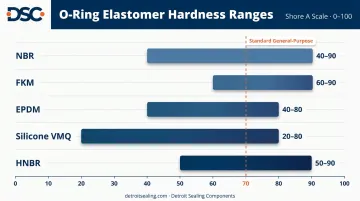
The same elastomer family can be compounded at different hardness levels to match application demands. For compounds outside these standard ranges, DSC's ISO 17025 accredited lab supports custom material development and testing across specialized applications.
Understanding Shore A Durometer Ranges for O-Rings
The Shore A scale functions as a decision tool, not a single recommendation. Each hardness band has distinct mechanical behaviors that map to specific application conditions.
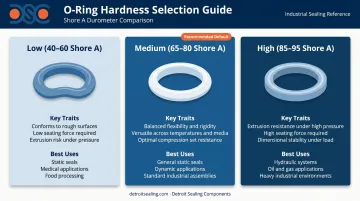
Low Durometer O-Rings (40–60 Shore A)
Soft O-rings deform easily under compression, conforming to surface irregularities and creating a seal on rough or irregular mating surfaces without requiring high seating forces. This conformity is the primary advantage at this hardness level.
Best suited for:
- Low-pressure static seals
- Medical device components
- Food processing equipment
- Pneumatic fittings
- Electronics enclosures where seating forces must stay low
Key limitation: Parker's data is direct on this—50 durometer materials tend to abrade and wear too quickly in dynamic service. Soft compounds also carry meaningful extrusion risk as pressure rises. Keep them in the static, low-pressure applications they're designed for. That constraint is also what makes medium-hardness materials the default for most general-purpose work.
Medium Durometer O-Rings (65–80 Shore A)
70 Shore A is the most widely used O-ring hardness—and for good reason. The Parker O-Ring Handbook identifies 70–80 Shore A as the most suitable compromise for most applications.
At 70A, an O-ring compresses under moderate seating loads to fill the groove and contact mating surfaces effectively, while remaining firm enough to resist permanent deformation under sustained pressure. It handles both static and dynamic applications across a broad range of pressures and temperatures.
Default to this range when conditions don't specifically call for softer or harder material—it's the right practical starting point, not a universal answer.
High Durometer O-Rings (85–95 Shore A)
Harder O-rings are specified when operating pressures are high, clearance gaps are larger, or abrasive conditions are present. The increased hardness limits the elastomer's ability to extrude into annular gaps under pressure.
Best suited for:
- Hydraulic cylinder seals
- Oil and gas wellhead equipment
- High-pressure fittings and valves
- Heavy industrial machinery
- Automotive engine components
High durometer O-rings do require greater compressive force to seat properly. Parker notes that 90 durometer materials may permit fluid bypass during dynamic cycling—the seal can become too rigid to maintain consistent contact through the stroke. On rough or out-of-tolerance surfaces, a 90A O-ring may simply not conform enough to seal.
Key Factors When Choosing the Right O-Ring Durometer
Durometer selection can't come from a chart alone. Each application brings its own pressure loads, motion types, surface conditions, temperatures, and chemical exposures—and each one shifts the optimal hardness range. Five factors govern that decision.
Operating Pressure and Extrusion Risk
As system pressure rises, the O-ring gets pushed toward the clearance gap between mating parts. If the elastomer is too soft relative to gap size and pressure, it extrudes—causing nibbling, tearing, or seal blowout.
Per the Parker O-Ring Handbook, extrusion is governed by three variables: fluid pressure, seal hardness, and diametral clearance. Parker's Figure 3-2 provides extrusion-limit curves for 70, 80, and 90 Shore A—use these as your pressure/gap reference.
Two additional notes from Parker:
- Backup rings should be evaluated at 1,500 psi (103.5 bar) for all seal types
- Silicone and fluorosilicone require a 60% reduction in allowable clearance from standard extrusion charts due to lower extrusion resistance
Backup rings extend the pressure range of softer O-rings, but treat them as supplementary. They don't compensate for a fundamentally incorrect hardness selection.
Static vs. Dynamic Application
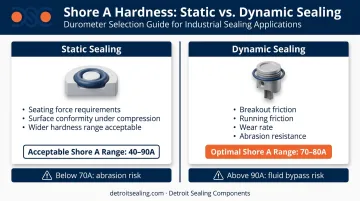
In static seals (face seals, flange seals, plug seals), durometer mainly governs seating force and conformity. A wider range of hardnesses is acceptable if the groove is designed correctly.
In dynamic applications (reciprocating pistons, rotating shafts, sliding rods), durometer directly affects breakout friction, running friction, and wear rate. Parker reports that breakout friction for 70 durometer rubber against an 8 micro-inch surface is typically three times running friction—that ratio matters for actuator design and wear calculations.
The dynamic sweet spot is 70–80 Shore A. Below that, abrasion becomes the failure mode. Above 90A, fluid bypass during cycling becomes the risk.
Surface Finish and Groove Tolerances
Rough sealing surfaces need softer O-rings. Parker's surface finish guidance:
- Static seals: surface roughness not exceeding 32 micro-inch RMS
- Face-type gas seals: 16 micro-inch RMS or better
When surface finish is coarser than these values, a lower durometer compound may be necessary to fill surface valleys and establish contact. Precision-machined bores with tight tolerances can accept higher durometer materials without leakage risk.
If groove dimensions are out of specification—too wide, too deep, or with excessive diametral clearance—durometer selection must compensate. Evaluate groove geometry and surface finish concurrently with hardness specification, not as a downstream check.
Temperature Range in Service
Temperature changes the mechanical behavior of any compound at its specified durometer. Elastomers stiffen at low temperatures and soften at elevated ones. A compound rated 70 Shore A at room temperature behaves considerably harder approaching cryogenic conditions.
Above its rated service temperature, that same compound loses extrusion resistance—even though nothing visible has changed.
Specify durometer based on the in-service temperature range, not ambient conditions. For precise hardness behavior at operating temperature, reference the compound-specific data sheet rather than family-level generalizations.
Chemical Exposure and Swell
Certain chemicals cause elastomers to absorb fluid and swell—which effectively reduces hardness and changes compression behavior. Others cause embrittlement and hardening over time. ASTM D471 covers rubber property changes after liquid exposure, including shifts in hardness, tensile strength, and elongation.
A seal that tests at 70A in air may behave like 50A after prolonged immersion in a hydraulic fluid or solvent. That change increases extrusion risk and compression set—without any visible sign of degradation until the seal fails. Durometer selection is incomplete without a chemical compatibility review of the specific fluid, concentration, and exposure duration.

How DSC Can Help You Choose the Right Durometer
Detroit Sealing Components brings decades of experience in the precision molded rubber industry to O-ring durometer selection. Their inventory spans hundreds of compounds across all major rubber families—NBR, FKM, EPDM, silicone, HNBR, and beyond—covering hardness ranges from 40 to 90 Shore A depending on the material.
For high-pressure applications, DSC stocks several ready-to-ship options:
- 90 durometer backup rings in both NBR and FKM, sized for the complete AS568 series
- Standard O-ring kits in NBR 70 and 90 durometer and FKM 75 and 90 durometer for immediate fulfillment
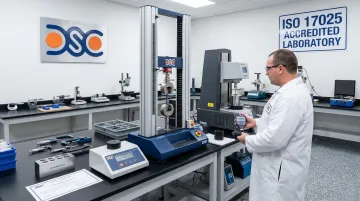
When standard compounds aren't sufficient, DSC's ISO 17025 accredited laboratory supports custom material development and hardness verification testing. Their technical staff evaluates pressure, temperature, surface condition, and chemical exposure together to recommend the right compound and durometer combination for the actual application.
DSC also uses finite element analysis to simulate seal behavior under real-world conditions before a single production part is made.
To work through a specific application, reach DSC's technical team at their Plymouth, Michigan headquarters: +1 313-887-4695.
Conclusion
The right Shore hardness depends on evaluating several factors together: pressure, motion type, surface condition, temperature range, and chemical compatibility. A 70 Shore A O-ring is the right starting point for most applications, but conditions vary enough that it won't always hold up.
Key factors to revisit when reassessing durometer:
- Operating pressure changes that push soft compounds to extrude or deform
- New motion types (reciprocating vs. rotary) that shift friction and wear demands
- Surface finish variations that affect how well the seal conforms and holds
- Temperature swings outside the compound's rated range
- Chemical exposure changes when fluids, lubricants, or cleaning agents are modified
Review O-ring durometer whenever operating conditions change, seals are replaced with a different compound, or wear patterns and leaks start recurring. Getting it right the first time saves downtime — getting it right every time requires treating durometer as a specification that evolves with your system.
Frequently Asked Questions
What hardness do O-rings typically come in?
Most standard O-rings are available in Shore A hardnesses ranging from 40 to 95, with 60–90 Shore A covering the majority of industrial compounds. The appropriate hardness depends on operating pressure, application type (static or dynamic), and the specific material compound being used.
What is the Shore hardness scale for O-rings?
The Shore A scale runs from 0 to 100—0 represents complete indentation with no resistance, 100 represents no indentation. Shore A is the standard scale for elastomeric O-rings; Shore D applies to harder plastics and rigid materials that exceed the elastomer range.
What is the difference between a 90 Shore A and a 70 Shore A O-ring?
A 90 Shore A O-ring is notably stiffer, offering greater extrusion resistance under high pressure but requiring more seating force and precise surface conditions. A 70 Shore A O-ring conforms more readily to mating surfaces and is the standard choice for general-purpose static and dynamic sealing.
What durometer should I use for high-pressure O-ring applications?
Most engineers specify 80–90 Shore A for high-pressure applications to resist extrusion through clearance gaps. Final selection depends on pressure level, diametral clearance, and whether backup rings are used—consult an extrusion resistance chart before specifying.
What happens if I use an O-ring with the wrong durometer?
An O-ring that's too soft will deform excessively under pressure, risking extrusion, nibbling, and seal blowout. One that's too hard may not compress sufficiently to seal properly on imperfect surfaces or in low-pressure systems, leading to leakage and accelerated wear on adjacent components.
How is O-ring Shore hardness accurately measured?
Shore A hardness is measured with a calibrated durometer that presses a standardized indenter into the elastomer. For finished O-rings with curved cross-sections, IRHD micro-hardness testing per ISO 48-2:2018 is more accurate than a standard Shore A gauge.